
Part I: The Unfinished Exclusions, Chapters 1–6
A word first, because this one is easy to read backwards. In law, exclusion usually belongs to the owner: the right to exclude others is often called the core of property, the thing that makes something yours. In philosophy it usually names the opposite fate, being shut out of the community of those who count, and slavery is the standard case. Orlando Patterson called it social death, and writers from Hannah Arendt to Charles Mills and Carole Pateman have traced other exclusions on the same pattern. Here the word stays legal but runs the other way: not what an owner may keep others out of, but what is kept out of ownership altogether, what Roman law called res extra commercium, things outside commerce.
An exclusion is the removal of a kind of being from the category of property. There are three. The first is the abolition of slavery: a person cannot be owned. The second, still unfinished, is the end of human rentals: a person cannot be rented. Once owning a person was gone, renting one remained: the employment contract buys not the person but the use of them, by the hour, for a wage that takes title to everything they produce. The third, barely begun, is the end of animals as property: no sentient being can be owned. The first was made by admitting people to the list of who counts, and that one list now stands in the way of the other two: it keeps the animal off, and it treats a rented person’s place on it as settling everything.
Three exclusions, and each a goal in its own right, with its own ground, its own history, its own opponents and its own work still to do. They are not picked at random. Property can hold a subject in two ways, by owning it or by renting its use; it has done both to people and the first to every other animal, and renting an animal presupposes owning it. The three exclusions are those holdings, named one by one. Three is what the test turns up today, not a ceiling on what it can turn up. The first two rest on the fact that no one can hand over their own agency, and the law itself holds a person answerable for what they do. The third rests on agency without that answerability: a being with ends of its own is not raw material, even when it cannot answer for anything.
What joins them is not a single argument but a single wrong, a subject used as an input. None of them stays won by itself, either. Even the first is held rather than settled: the Thirteenth Amendment still permits involuntary servitude as punishment for crime, which is neither ownership nor rental but the state holding a person’s labor without either.
Each exclusion has to be reached in full, then kept. That sounds monumental, but what stands in the way is not nature. Property in a person, or in a sow, is a human construct, a way of seeing handed down rather than a fact found, and what was learned can be unlearned once it is seen for what it is. None of these goals is new. People already believe in them, and are working for them now. What follows examines how the first exclusion was made, through the list of who counts, and why that list has kept the other two from being made.
Chapter 1
A breeding sow stands in a metal crate about two feet wide and seven feet long. She cannot turn around. In the systems that still use these, she will spend much of her adult life that way. Why? A person can be confined to a cell, but only for an infraction, and the law has to find one first: a charge, a hearing, a sentence. Punishment at least assumes someone who can answer for what they did. The harshest cell we build for people, solitary, is still about four times the size of the crate. What was the sow’s infraction? There is none. She was born on the wrong side of a line some humans drew. The crate is not sized to anything she did. It is sized to what she yields. A fenced field would be sized the same way, only larger: “bigger cages, longer chains,” the same measure.
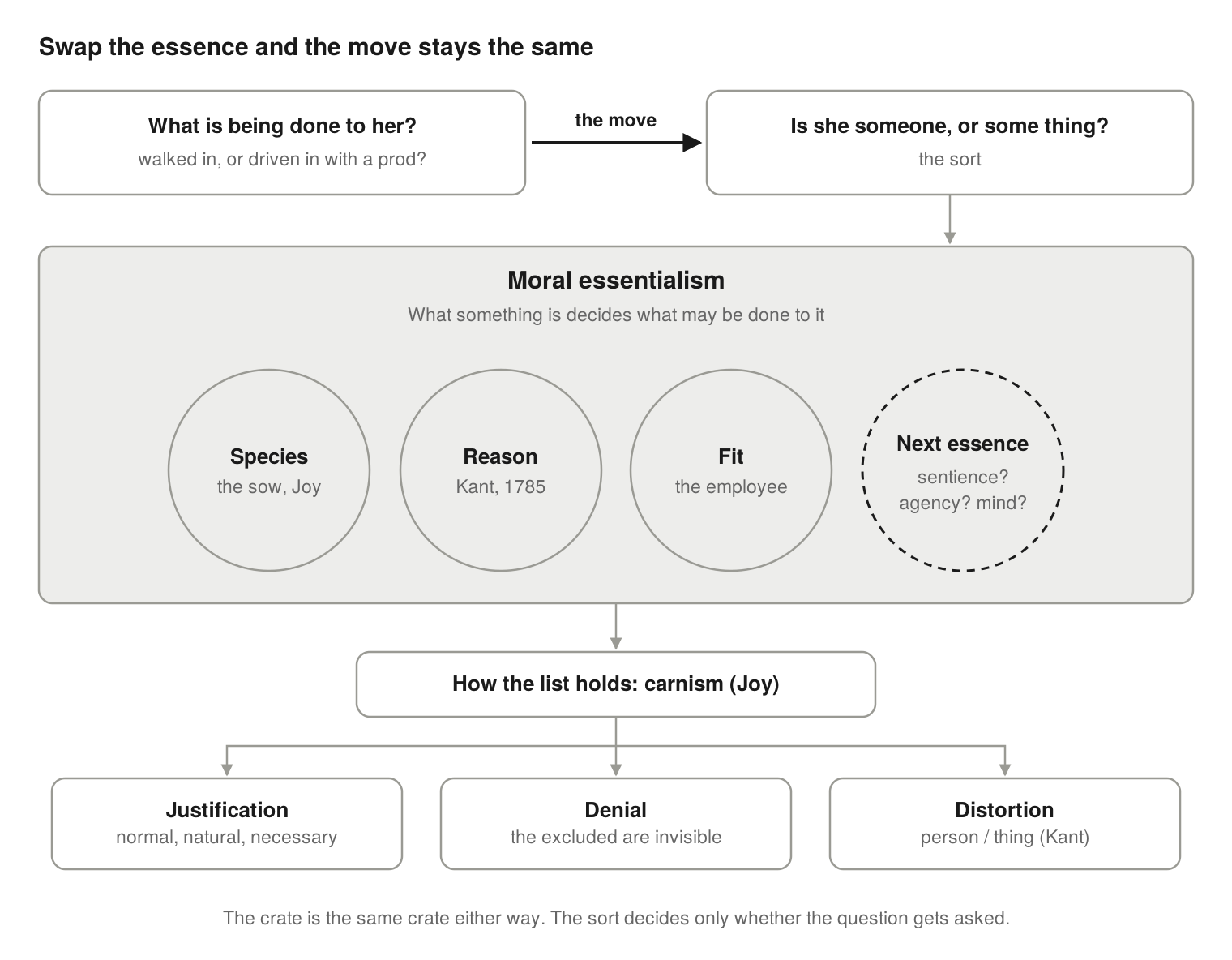
The usual answer is: it’s a pig. And the matter closes — not because anyone weighed the crate against the animal standing in it, but because she was sorted, and lands outside the list of who counts, the beings a question may be asked about, and does not get the question asked.
That is the move. There is a question on the table — what is being done to her, and is it all right? The move swaps it for another — is she someone, or some thing? — then treats the answer to the second as the answer to the first. The title alone of Melanie Joy’s book states part of the answer: Why We Love Dogs, Eat Pigs, and Wear Cows: An Introduction to Carnism. Of course in some places eating dogs, and sometimes cats, is on the list.
It runs the same way on people. Someone works a job on terms they had no hand in setting. Asking why, or whether it is all right, is closed. Nobody looked at the job, just the “employee.” The usual answer: if they don’t like the terms or the job they can look for a better one, advocate for better, or if they don’t or can’t they can get a job elsewhere.
Now notice what the sorting contributes. Nothing. The crate is the same crate and the job is the same job whether you sort first or not. Which side of the list a being lands on tells you nothing about what is being done to it. All it decides is whether you are allowed to ask. And nobody asks the sow how she got there — whether she walked in, or was driven in with a prod.
Kant’s sort
The sort has a pedigree. In 1785 Kant split beings in two: those with reason are persons, ends in themselves; those without it have worth only as means, and are therefore called things. Someone or some thing, written down as a principle — and what may be done to a being follows from which side it falls on.
The pedigree has a name: moral essentialism, the view that a fixed core quality settles what may be done to a being. The trouble is not that beings have natures — a sow is a sow — but that the nature is made to decide. Species is only the most familiar essence put to that use; Kant’s was reason, and the employer’s is fit. Swap one for another and the move is the same.
It is the move in its most respectable form. Every sort-then-permit step looks like a jump from an is — she’s a pig, she lacks reason — to an ought: so the crate is fine. It only looks that way. As the next section shows, an ought premise is riding along unstated. Kant did not escape Hume so much as supply that premise and place it in reason rather than in facts. But picking reason as the qualification for personhood is still a choice, and it is the wrong one for the job. Reason is what makes a being a moral agent, one that can owe: be held to a promise, answer for what it did. It says nothing about whether a being is a moral patient, one that can be wronged: harmed, confined, used. A person is both. Kant fuses them, so only those who can owe can be wronged, and nothing done to an animal can wrong it.
Kant did not think anything goes. In his lectures on ethics he condemned cruelty to animals, on the ground that someone who is cruel to animals grows hard in dealing with people. But notice where the wrong lands. The duty is owed to people, and the animal is only the occasion for it. She is protected as a thing whose mistreatment might harden someone toward people. That is the sort still doing its work inside the kindness.
Kant can be turned against Kant, and a Kantian has done it. Christine Korsgaard’s argument in Fellow Creatures runs roughly: when we value our own ends, much of what we are valuing is our good as creatures: being free from pain, and free to move. That is animal nature, not rational nature. Hold that it matters in us, and consistency says it matters in the sow. Consistency has no use for a list.
Is and ought
Hume’s point is narrower than it is usually taken to be. An ought cannot come from an is alone. It needs an ought premise to travel with. Lay the crate out that way:
- Is: the crate keeps the sow from turning around for most of her life and causes her serious suffering: stress behaviors, physical decline, and the drives to root, nest and move left with nowhere to go.
- Is: what the crate is for, fewer fights and easier feeding and handling, can largely be had with group housing that causes far less suffering.
- Ought: it is wrong to cause serious suffering to a sentient animal when a less harmful alternative would meet the same legitimate goals.
- So: the crate is wrong.
That ought is deliberately modest. Nearly everyone who defends the crate already accepts it, which is what makes it useful: the argument borrows nothing the reader has not already signed. It is not where this argument ends. Taken alone, it would condemn the crate and approve a roomier pen on the way to the same slaughter, which is humane instrumentality, discussed later. What the minimum shows is that even the reader’s own ought reaches the crate. The rest of the argument asks why it should stop there.
Few who defend the crate deny that she suffers. What they change is the ought, and rarely by saying that only persons count. The common version sounds humane, and it is written into law. Many American anti-cruelty statutes forbid causing an animal unnecessary suffering, then exempt the customary practices of farming. Laid out, it looks complete:
- Is: crating is standard practice.
- Ought: causing suffering is wrong only when it is unnecessary.
- So: the crate is not wrong.
It isn’t complete. Nothing links the first two lines until you add the one that goes unsaid:
- Hidden premise: whatever the industry does as standard practice is necessary.
That is the sort-then-permit move taken apart. The hidden line is phrased as a fact, a definition of necessary, but it does an ought’s job: it decides whose suffering may be set aside, and the definition is written by the people doing the crating. Her suffering is admitted and counted, then defined away. The list does not live in the facts. It lives in a premise dressed as one, where nobody looks.
The other common version doesn’t redefine anything. It counts her suffering, then discounts it:
- Is: she is a pig, and the crate keeps pork cheap and farms solvent.
- Ought: animal suffering matters, but less than significant human interests.
- So: the crate is not wrong.
This one states its premise openly, which makes the edit easier to see. She is counted, then marked down, and the rate is set by what she is, not by anything about the crate. The list is still there. It has just stopped being a wall and become a weight.
The worker runs the same way:
- Is: he agreed to the terms.
- Ought: whatever someone agrees to is permissible.
- So: the job is fine.
Here nothing is hidden. The premise is inflated instead, asked to settle more than any agreement can. That is why consent is one of the checks: it is an ought premise dressed as a fact about a signature, and only those on the list are allowed to sign.
One more thing follows. Every exclusion is a normative claim, and every restriction adds another ought to defend. Leaving a being alone is an ought too, a default, and it should be admitted as built rather than found. But it is the cheapest one to defend: it claims the least and takes nothing, so it rests on fewer premises than any arrangement that confines or directs. The more an arrangement excludes, confines or directs, the more oughts it rests on, and the more of them can fail. The burden grows with the claim. Nor is the default always simple to honor. An animal bred over generations to depend on us is not served by being left alone, and there the cheapest ought is care without use. Bred for what end but captivity? Abolition means not bringing more beings into it. The fuller argument needs a book of its own.
“Rights” do not escape this either. So-called natural rights are oughts presented as found; admitted as built, they can at least be tested. This is an old fight inside the individualist tradition. L.A. Rollins’s The Myth of Natural Rights (1983) and Robert Anton Wilson’s Natural Law, or Don’t Put a Rubber on Your Willy (1987) took it to the natural-rights libertarians, Rothbard among them. Wilson drew the line drawn here: law as a description of what nature does is science; law as what nature commands is ventriloquism, someone’s ought spoken through nature’s mouth. The version of inalienability worth keeping is plainer: agency does not transfer, so arrangements have to keep answering to the agents inside them, over and over, with no one buying or selling their way out of that work. Among people who share a language, that can mean negotiating. With a being that cannot tell us its terms, it means reading what it does, and where the reading is uncertain, erring on the side of caution.
Sources and further reading
A note on sources for Part I, chapters 1–6. Some thinkers used in this book would not all follow it where it goes. David Ellerman, whose case against the renting of persons sits at its center, is no left libertarian. He accepts interest on capital, looks to the law to end the employment contract, and presents his view as neither capitalist nor socialist. Elinor Ostrom was neither a mutualist nor a theorist of inalienable rights, and her work warns against any single rule applied everywhere. The exclusions are not meant as such a rule: they set a floor on who may be owned or rented, and leave the rules above it to those who live under them, much as her own design principles do. The mutualists, from Warren to Carson, rest their case against interest and rent on a labor theory of value as well as of property; this part shares the second and finds the first plausible, but does not rely on it. Others drawn on here, Kant, Rothbard and Kurtz among them, would object to more still. Each borrowing is named where it is made; the combination, and whatever goes beyond its sources, is this book’s own. Nor is it offered as a program, or as a remedy for everything. It is a possible synthesis, one way these pieces might fit together, put forward because the fit seems sound and rooted in liberty and justice, and open to testing like everything else here. A fuller account of the theory behind it is forthcoming.
- Immanuel Kant, Groundwork of the Metaphysics of Morals (1785). Persons as ends, everything without reason as things. Also: Lectures on Ethics (Collins notes, c. 1784–85; English translation, Cambridge University Press, 1997), on indirect duties regarding animals.
- David Hume, A Treatise of Human Nature (1739–40), Book III, Part I, Section I. The is–ought gap.
- L. A. Rollins, The Myth of Natural Rights (Loompanics, 1983).
- Robert Anton Wilson, Natural Law, or Don’t Put a Rubber on Your Willy (Loompanics, 1987).
- Christine M. Korsgaard, Fellow Creatures: Our Obligations to the Other Animals (Oxford University Press, 2018).
- Melanie Joy, Why We Love Dogs, Eat Pigs, and Wear Cows: An Introduction to Carnism (Conari Press, 2009).
- “Bigger cages, longer chains”: a chant reported from the 1981 Toxteth riots in Liverpool, used to shout down a proposal to organize the rioters from outside (New Standard, London, July 1981, as quoted in Chris Shutes, On the Poverty of Berkeley Life and the Marginal Stratum of American Society in General, 1983).
- Animal Legal Defense Fund, “Customary Cruelty in the Farm Industry: When Animal Abuse is Legal.” How state anti-cruelty laws exempt “customary farming practices,” leaving the industry to define what is legal.
- State customary-practice exemptions, for example: Wash. Rev. Code § 16.52.185 (“accepted husbandry practices”); Tex. Penal Code § 42.09 (generally accepted animal husbandry or farming practice); Mich. Comp. Laws § 750.50 (“customary animal husbandry or farming practices involving livestock”).