home

Exploring Libertarianism

Like self-organizing systems in nature, social order can emerge from the free interaction of many people rather than being imposed from above. When those interactions are voluntary and respect others’ freedom, and when people have cast off domination, order grows out of liberty instead of opposing it. In this view, anarchism is less a finished blueprint than an ethic and a process: an ongoing effort to build a freer, more just world without handing control to any single authority.

Anarchy is Order? That is where the circle A comes from, or so goes the story. In 1850 Anselme Bellegarrigue, a French individualist anarchist, published L’Anarchie, journal de l’ordre, often called the first anarchist manifesto, which declared that “anarchy is order, whereas government is civil war.” The idea itself comes from Pierre-Joseph Proudhon. In What Is Property? (1840), he wrote that just as people seek justice in equality, society seeks order in anarchy. He later put it as “anarchy is order without power.” Bellegarrigue turned that idea into the short slogan Anarchy is Order.

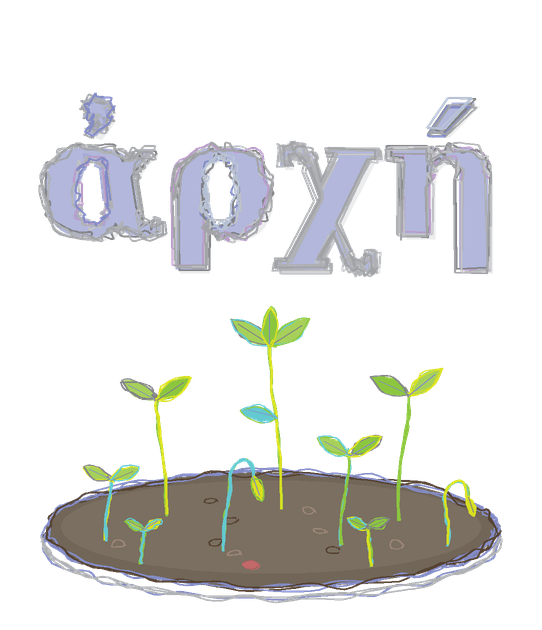
One vision, Anarchy as Order, with many paths to that “end,” individualist and collectivist alike. Order is derived from the chaos of many paths, each with a beginning (Alpha, A) and an end (Omega, O, last letter in the Greek alphabet), and perhaps also “without origin” or end. In Greek, ἄρχων (archōn), ruler, and ἀρχή (arkhē), beginning or origin, share a root in ἄρχειν (archein), which means both “to begin” and “to rule.” The one who began was once simply the one who went first; the ruler is the one who claims to be the only beginning, from whom all order must flow. Anarchy keeps beginnings plural. Are rulers the end of experiments, birth, or ultimately beginnings?

The popular notion of chaos is randomness and disorder, and anarchy is likewise seen as chaos, not order. The common line of thought is a non sequitur: chaos is bad, anarchy is chaos, therefore anarchy is bad. Besides confusing anarchy with anarchism, it gets chaos wrong too.

Chaos Theory is a field of mathematics showing that behavior that looks random can arise from simple, deterministic rules and hide a deeper order. Fractals (depicted below) are one picture of this: self-similar patterns repeating across scales, generated by feeding an equation’s output back into itself over and over. Oddly enough, although the process is deterministic, the result is not predictable. A system’s future path is set by its initial state, with no randomness involved, yet the smallest change in that state can send it down a completely different road.

Human interaction is like the Butterfly Effect: a small change can snowball into very different outcomes. Every little decision and bit of feedback affects what comes next, which makes prediction hard. Chaos.

States build linear, cause-and-effect thinking into their very structure: rigid, “orderly,” top-down patterns, with a window dressing of order from below. They try to control outcomes through deterministic inputs, yet still produce chaos, often of the worst kind. Libertarianism/Anarchism, recognizing the sovereignty of the individual over that of the state, accepts that the input is chaos and so is the output. The difference is in the feedback: under the state, a few decide and everyone else absorbs the consequences, while under anarchism, everyone’s choices shape the pattern, and liberty is what gets amplified.

To stretch the metaphor further: anarchism is almost quantum. It is nonlinear and interested in the very small, the individual. And to borrow from Heisenberg, the closer we get to measuring the momentum of anarchist action for change, the less we can pin down the position of any one anarchist, and vice versa.

Take-home lesson? Live in the moment, don’t expect perfect outcomes, interact, give feedback, and make sure the initial state is a good one, realizing that by being an ass in the process, you could snowball into a pattern of repeating asses. Since we don’t need the amplification of asses, the chaos of anarchism and the amplification of liberty seem a far more beautiful future than a goose-stepping bureaucracy that smells like ass.

Martin Elson