
Martin Elson
Power Distance ended on a pattern older than any market. Need makes deference, and money compounds: to those who have, more is given. Sociologists call it the Matthew effect, after the parable of the talents: “unto every one that hath shall be given, and he shall have abundance” (Matthew 25:29). Robert Merton named it in 1968, when he noticed that famous scientists got more credit than unknown ones for the same discovery. The idea has since spread to money, schooling and fame: an early lead attracts the resources that make the next lead easier. Markets Versus Capitalism ended on a question about it. When the biggest firms win, are they rewarded for serving people better, or simply for being big?
This chapter follows the chain from size to finance. Size wins bids and terms. Leverage works in two senses, size as power and debt as power, and the two meet in the leveraged buyout. Above them sits Wall Street, the casino, where securities, hedges, inflation and a market in whole companies all ride on one bet: growth. None of these is bad in itself. A large firm can make things cheaper, a loan can build a workshop, a hedge can protect a farmer, and a company can be sold to people who will run it better. Each can also end up on a bad path when profits come before people. The question is what decides which path it takes.
Efficiency or leverage
Start with the honest case for size. Some things really are cheaper in bulk. A steel furnace, a container ship or a chip plant costs a fortune to build and little to run once built, so the more it produces, the less each unit costs. Alfred Chandler, whose case got a first hearing in the last chapter, showed how railroads, steel and mass retail learned to coordinate flows that many small firms couldn’t. Ronald Coase asked why firms exist at all and answered that dealing through a market has costs of its own: finding partners, haggling, enforcing contracts. A firm grows until doing one more thing inside costs more than buying it outside. On this view the giant is simply where those costs balance. Walmart’s prices are partly the reward for real logistics: bar codes, cross-docking, trucks that rarely run empty.
Kevin Carson’s reply, in Organization Theory: A Libertarian Perspective (2008), doesn’t deny economies of scale. He argues that they mostly run out at a modest size, the size of a plant, not a corporation. Past that point bigness brings its own costs: layers of managers who can’t see the shop floor, information that travels up distorted, and the same knowledge problem Hayek found in central planning, now inside the firm. A firm that keeps growing anyway is growing for something other than efficiency: power over suppliers, buyers, workers and regulators. And much of that growth, Carson argues, rests on privileges the last two chapters named: subsidized transport, patents, contracts sized for giants, and a tax code that favors debt.
Both sides make an empirical claim, so they can share a test. Strip away the subsidies, the contracts only giants can bid on, and the legal privileges. Does the giant still win? Where it does, its size was earned and it serves people. Where it doesn’t, the size was leverage, and the margin it protects is the one Markets Versus Capitalism called taken rather than made. The rest of this chapter looks at where size and money win without that test ever being run.
Size wins bids and terms
The first advantage of size is the simplest: some games only the large can enter. The last chapter met the contract bundled so big that only a handful of firms can bid, and the Pentagon dinner that turned dozens of defense contractors into five. Each round feeds the next. The winner gains the record, the staff and the lobbyists to win the next contract, and the agency gains a reason to keep it, since it has no one else.
The second advantage is terms. A buyer big enough can dictate to its suppliers. Charles Fishman’s The Wal-Mart Effect(2006) tells of Vlasic selling a gallon jar of pickles through Walmart for $2.97, a price that moved enormous volume and cut the company’s pickle profits by a quarter or more. Vlasic asked to raise it and was refused; it couldn’t afford to walk away from a customer that bought its other products too. Economists call this monopsony, the buyer’s version of monopoly. It is the leaving test from the other side: the supplier can see the cost, but can’t leave.
The third advantage is money itself. A large firm borrows more cheaply than a small one, partly because it is safer and partly because lenders expect someone to step in if it isn’t. In March 2020, when markets froze, the Federal Reserve announced it would buy corporate bonds, and the announcement alone brought borrowing costs down for the largest companies, which went on to borrow heavily in the bond market that year. The Fed’s Main Street Lending Program, meant for midsize firms too small for that market, made about $17.5 billion of loans out of the $600 billion it was authorized to buy, roughly 3 percent. The cheap money flowed first to those already closest to it.
None of these advantages is efficiency in Chandler’s sense. A firm that wins because only it may bid, because its suppliers have nowhere else to go, or because it borrows on the public’s credit hasn’t shown that it serves anyone better. It has shown that it is big.
Leverage, in both senses
“Leverage” has two meanings, and the overlap isn’t an accident. In plain English it means power: the advantage the last section described, where size lets one party set the terms. In finance it means debt: buying more than you could pay for with your own money. Both multiply. A lever lets a small push move a heavy load, and borrowed money lets a small stake control a large company. Both also multiply losses, and who bears the loss decides whether the lever is a tool or a weapon.
The tax code tilts toward debt. In the United States a firm can deduct the interest it pays on loans from its taxable income, but not the dividends it pays to owners. So the public pays part of the cost of any company financed by borrowing. The 2017 tax law capped that deduction for large firms, but the tilt remains.
The two meanings meet in the leveraged buyout. A buyer, usually a private-equity firm, buys a company with a little of its own money and a great deal of borrowed money, and then puts the debt on the company it bought. The buyer owns the firm; the firm owes the loan. In 2005 KKR, Bain Capital and the real-estate firm Vornado bought Toys “R” Us for $6.6 billion, putting in about $1.3 billion of their own and loading roughly $5 billion of debt onto the retailer. For twelve years it paid around $400 to $500 million a year in interest, more than it spent on new stores or on a website that might have competed with Amazon. Meanwhile the three owners collected roughly $464 million in advisory fees, transaction fees and interest. The chain filed for bankruptcy in 2017 and closed its US stores the next year. About 33,000 people lost their jobs, most without severance.
The buyers lost their equity, so this was no clean win for them. But look at who carried what. The buyers’ loss was capped at their stake, and the fees came out first. The workers had no stake and no say, and lost everything the job paid for. That is leverage in both senses at once: the debt multiplied the bet, and the power to set terms decided who paid when the bet failed.
The casino
Braudel’s top floor still has a trading room. Most of what happens on Wall Street isn’t raising money to build anything. It is trading claims on things already built: shares, bonds, loans bundled into securities, and bets on all of them. Each instrument has an honest use. A wheat farmer who sells a futures contract in spring locks in a price for the autumn harvest; that is insurance, and the speculator who takes the other side earns a fee for carrying the risk. A share lets savers own a slice of an enterprise they could never run. The trouble starts when the bets grow larger than the things they are bets on, are made with borrowed money, and someone else is expected to cover the losses.
That last condition is what turns a market into a casino with a house that can’t lose. In 1998 the hedge fund Long-Term Capital Management, run by Nobel-winning economists, had borrowed some twenty-five times its own capital. When its bets went wrong, the New York Fed gathered fourteen banks in a room and had them put in $3.6 billion to wind it down quietly. In March 2008 Bear Stearns, Wall Street’s fifth-largest investment bank, ran out of cash in a weekend; the Fed agreed to take on about $30 billion of its mortgage securities so that JPMorgan would buy it, and opened its lending window to investment banks for the first time. Charles Johnson’s post at the time, “Small Enough to Fail,” caught the moral in its title. The banks were too big to fail; you, he told his readers, are small enough. That autumn the government began rescuing the insurer AIG, whose bets on mortgage bonds had gone bad. The commitment grew to about $182 billion, and much of that money passed straight through to the banks that had placed them.

The rescue doesn’t only happen in a crisis. Lenders know it is coming, so they lend to the biggest banks more cheaply in ordinary years too. In 2014 the IMF estimated that this expectation was worth $15 to $70 billion a year to the largest US banks, and far more to their European counterparts. That is a subsidy no budget lists, paid in the form of risk the public is expected to carry.
Sheldon Richman, writing during Occupy Wall Street in 2011, made the list longer. Wall Street, he argued, couldn’t have done it alone. It took a government and its central bank to put up barriers to entry that sheltered existing banks, to supply cheap credit that made shaky mortgages profitable, to license the rating agencies that stamped bundles of those mortgages AAA, to create Fannie Mae and Freddie Mac to buy them, to insure deposits so savers had no reason to ask what their bank was doing, and finally to make the taxpayers pay when it all came down. His advice to the protesters: keep protesting outside Goldman Sachs, but also outside the Fed, the Treasury and the Capitol.
Inflation belongs on the list too, though more quietly. New money doesn’t arrive everywhere at once. Richard Cantillon noticed in the 1730s that those who receive it first, close to the source, spend it before prices rise, while those who receive it last, usually in wages, find prices have already risen. Today the source is the central bank and the first receivers are banks and the holders of financial assets. Johnson called this an upward transfer from wages and savings. Most economists would put it more mildly and say that the Fed’s rescues kept 2008 from becoming a depression, which hit wage earners hardest of all. Both can be true. A rescue that saves the system can still choose whom to save first, and in 2008 it chose the casino.
Inflation also bears on the question of price and cost. A markup above cost raises a price once; it can’t keep prices rising year after year unless new money keeps arriving to pay it. Most new money today is created by banks lending at interest, so the money supply grows as debt. Mutualists such as William Greene and Benjamin Tucker saw interest as the price of a legal monopoly on issuing money, and on their view steady inflation is one way that price gets collected, from wage earners last of all. Most economists see interest instead as payment for waiting and risk; Cost the Limit of Price takes up that dispute.
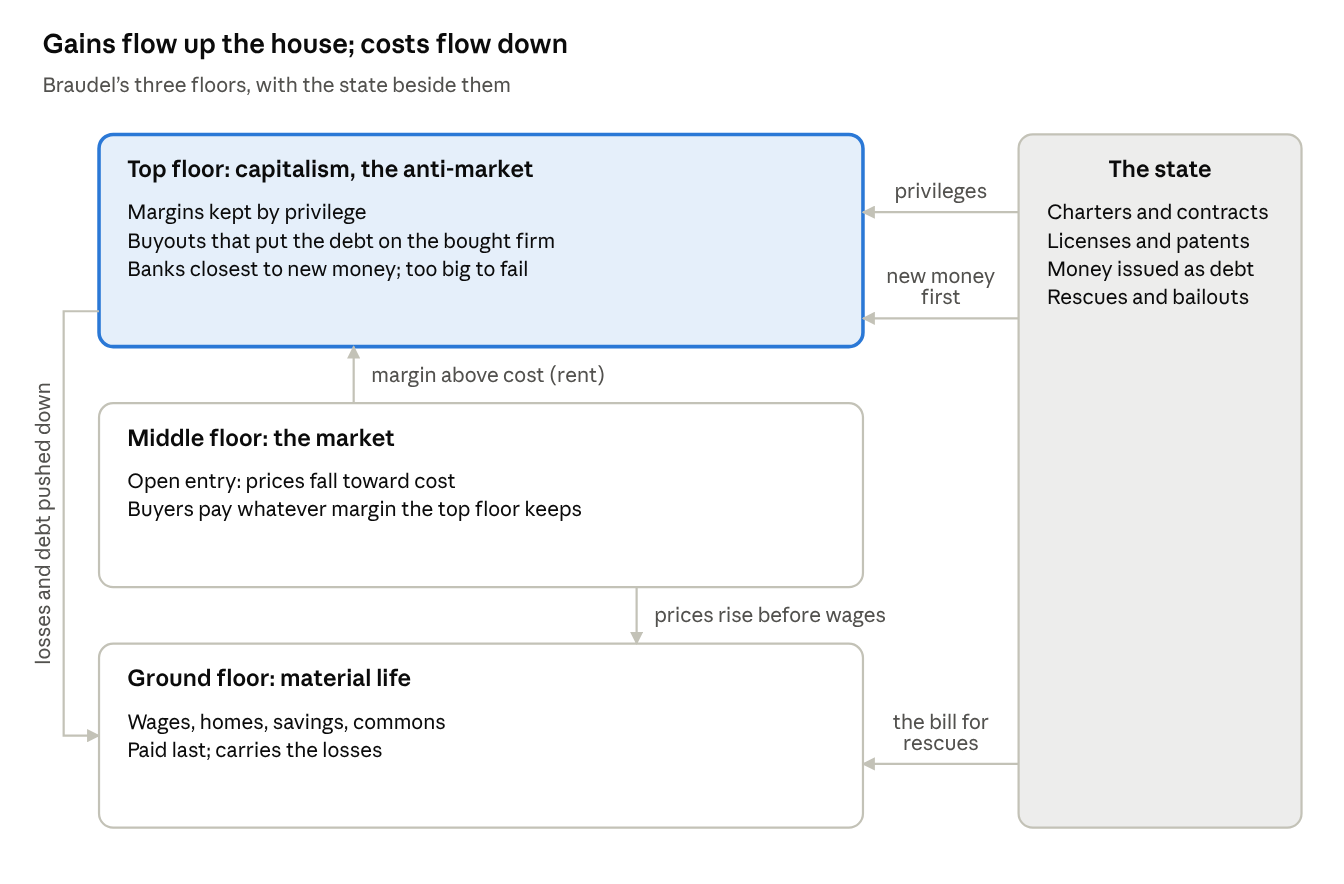
Privilege and new money enter at the top; the margin above cost is drawn up from the market; rising prices, the bill for rescues, and the losses of failed bets land on the ground floor. Notice what leaves when the state does. Three of the arrows start in its box: privileges, new money first, and the bill for rescues. Take the box away and those three go with it. The margin above cost loses what protected it and gets competed down, and the losses of a failed bet fall back on whoever made it, instead of being pushed down to the ground floor.
The strongest objections
The best defense of the buyout is Michael Jensen’s, in “Eclipse of the Public Corporation” (Harvard Business Review, 1989). Jensen agreed with Carson about one thing: managers of large public companies like to build empires. A firm with spare cash and scattered shareholders will spend it on acquisitions, headquarters and pet projects rather than hand it back. Debt, Jensen argued, is the cure. A company that owes large interest payments every quarter can’t waste money, and owners with a big stake watch closely. On this view the market in whole companies is how bad management gets replaced, and the buyout firm is a discipline, not a raider.
The evidence gives him something. A large study by Steven Davis, Josh Lerner and colleagues, covering thousands of US buyouts, found that labor productivity at bought firms rose about 8 percent over two years compared with similar firms. Employment depended on the deal: it rose about 13 percent after buyouts of privately held firms and fell about 13 percent after buyouts of publicly listed ones, the kind Toys “R” Us was. Not every buyout is Toys “R” Us.
The broader defense of finance runs the same way. Without a market for shares and bonds, savers couldn’t fund firms they don’t run, founders couldn’t sell out and start again, and risk couldn’t go to those best able to carry it. A futures market lets the farmer sleep. Calling all of it a casino throws out the market for capital along with the gambling.
These objections are right about what finance can do. Jensen’s discipline is a real force, and a firm that wastes money deserves to change hands. But notice what each defense assumes. The discipline works because the debt is real and the lender expects to be paid. Once lenders expect a rescue, the discipline is gone, and that is the condition the IMF measured. The market for capital works when people can see what they are buying, which the AAA-rated mortgage bundles of 2007 made impossible. And Jensen’s own picture has no place for the workers. In his account the conflict is between managers and owners, and debt settles it in the owners’ favor. The people who do the work appear only as a cost, and when the buyout fails, they pay first. That is the question the next section turns to: who the company is.
Corporations as people, corporations made of people
In law, a corporation is a person. The idea entered American constitutional law almost by accident: in Santa Clara County v. Southern Pacific Railroad (1886), the Supreme Court’s reporter wrote in a summary at the top of the case that corporations are persons under the Fourteenth Amendment, though the opinion itself didn’t decide the point. Later courts treated the note as settled law. In Citizens United v. FEC (2010) the Court, five to four, held that the government may not limit independent political spending by corporations and unions. Its defenders, the ACLU among them at the time, point out that the case began with a nonprofit’s film about a candidate, and that people don’t lose their right to speak by speaking together. That is a fair point, and it applies to a union or a co-op as much as to Exxon. But people speaking together don’t need a new person to do it; they already have their own rights. Corporate personhood adds a second, artificial person on top of them, made by charter, with limited liability and unlimited life, privileges no partnership of individuals has. It can claim the rights of a person, to speak, to due process, to equal protection, while answering for nothing the way a person must: it can’t be jailed, it doesn’t die, and its owners risk only what they put in. Rights belong to persons, and an association exercises its members’ rights, not rights of its own. The state makes the person, and then the person buys influence over the state.
The other sense matters more here. A corporation is made of people, and the law forgets them at the moment that counts. When a company is sold, its workers go with it, like the furniture. They weren’t asked and they aren’t party to the sale. The Toys “R” Us workers didn’t agree to carry $5 billion of someone else’s debt; the debt was simply put on the firm they worked in. In what other setting do people pass from owner to owner with the building?
David Ellerman’s answer, set out in Labor and Property, is that they shouldn’t. What gets sold in a buyout isn’t only machines and buildings. It is the right to hire the workforce and to claim what it produces, and Ellerman argues that this right isn’t property at all. It is just the position of whoever does the hiring. If the workers hired the capital instead, renting machines and borrowing money as any firm does, the same position would be theirs, and nobody could sell it out from under them. That is a worker cooperative. Mondragón in the Basque Country, founded in 1956, has grown into a federation of cooperatives employing tens of thousands, and it doesn’t do leveraged buyouts of itself. A cooperative can still borrow, fail and close. What it can’t do is be sold with its members inside, or load its members with debt they never agreed to.
What to keep
Size isn’t the enemy, and neither are debt, hedging or the sale of a company. Chandler and Coase are right that some things are cheaper done big, and Jensen is right that a firm wasting money should change hands. The test from the start of the chapter still sorts the cases. Where a giant wins after the subsidies, the sized-up contracts and the rescues are taken away, it has earned its size. Where it wins only with them, its size is leverage, and its margin is taken rather than made.
What the chapter adds is a second test, about who carries the loss. Every lever multiplies both ways. When the people who choose the bet also carry its downside, leverage is a tool. When the gain goes to those who chose and the loss to those who didn’t, to workers sold with the firm or taxpayers behind the bank, it is a weapon. Too big to fail, the buyout that puts the debt on the bought, and the corporation that is a person when it speaks but a thing when it is sold all fail that test the same way.
Would the casino survive without a state? Some betting would. People would still speculate, and farmers would still hedge, through mutual insurance and cooperative exchanges. What would go is the house that can’t lose: no lender of last resort, no too big to fail, no monopoly on issuing money, and far less limited liability. Leverage would be capped by real savings and by gamblers who pay their own losses. Bubbles did come before central banks, but the most famous ones, the South Sea and Mississippi bubbles of 1720, grew on state-chartered monopolies. Scotland’s era of free banking, from 1716 to 1845, is the usual counter-example, and its record is disputed. So this is an empirical bet, and the test is the one the last chapter set in advance.
That pattern, gains kept close and costs sent outside, isn’t limited to finance. It is what a factory does when it pours waste into a river, and what a lender does when it sends a poor country the bill for a project that enriched someone else. Those costs pushed outside are the subject of the next chapter.
Sources
- Robert K. Merton, “The Matthew Effect in Science” (Science 159, 1968). The name for advantage that compounds.
- Alfred D. Chandler Jr., The Visible Hand: The Managerial Revolution in American Business (Belknap Press, 1977). The big firm as better coordination.
- Ronald H. Coase, “The Nature of the Firm” (Economica 4, 1937). Why firms exist: the costs of using the market.
- Kevin A. Carson, Organization Theory: A Libertarian Perspective (BookSurge, 2008). Economies of scale exhausted at modest size; growth past it as power, built on privilege. original
- Charles Fishman, The Wal-Mart Effect (Penguin Press, 2006). The Vlasic pickle jar; the buyer’s power over suppliers.
- Michael C. Jensen, “Eclipse of the Public Corporation” (Harvard Business Review, Sept.–Oct. 1989). Debt as discipline on empire-building managers.
- Steven J. Davis, John Haltiwanger, Kyle Handley, Josh Lerner, Ben Lipsius and Javier Miranda, “The Economic Effects of Private Equity Buyouts” (NBER Working Paper 26371, 2019). Productivity gains; employment effects that differ by type of buyout.
- Private Equity Stakeholder Project, “KKR, Bain Capital, Vornado repeatedly rewarded themselves for adding debt to Toys ‘R’ Us” (May 29, 2018). The equity, the debt and the fees. original
- Sen. Elizabeth Warren et al., letter to Vornado Realty Trust on Toys “R” Us (Oct. 16, 2018). Interest against operating profit, 2005–2017. original
- Charles W. Johnson, “Small Enough to Fail” (Rad Geek People’s Daily, Mar. 19, 2008). The Bear Stearns rescue and who pays for it. original · copy here
- Sheldon Richman, “Wall Street Couldn’t Have Done It Alone” (CounterPunch, Oct. 14, 2011). The government’s part in the 2008 crisis, item by item. original · copy here
- Roger Lowenstein, When Genius Failed: The Rise and Fall of Long-Term Capital Management (Random House, 2000). LTCM’s leverage and the Fed-brokered rescue.
- International Monetary Fund, Global Financial Stability Report (April 2014), ch. 3, “How Big Is the Implicit Subsidy for Banks Considered Too Important to Fail?” summary
- Richard Cantillon, Essai sur la nature du commerce en général (written c. 1730, published 1755). Who receives new money first.
- Santa Clara County v. Southern Pacific Railroad Co., 118 U.S. 394 (1886). The reporter’s headnote on corporate personhood.
- Citizens United v. Federal Election Commission, 558 U.S. 310 (2010).
- David Ellerman, Property and Contract in Economics: The Case for Economic Democracy (Blackwell, 1992). The firm’s hiring position as a contractual role, not property. free from the author
- William B. Greene, Mutual Banking (1850). Interest as the price of a monopoly on money; the case for mutual credit.