The historical Classical Liberal debate between consent vs. coercion, or within the sphere of consent itself, came down to Delegation vs. Alienation, and coercion was seen as neither delegation nor alienation for reason.
| Coercion | Consent | Consent |
| Alienation (translatio) | Delegation (concessio) |
The table above maps to the blue model of institutions on the left-side below, whereas Ellerman proposes the model on the right as the correct framing (Ellerman’s originals (also see)):
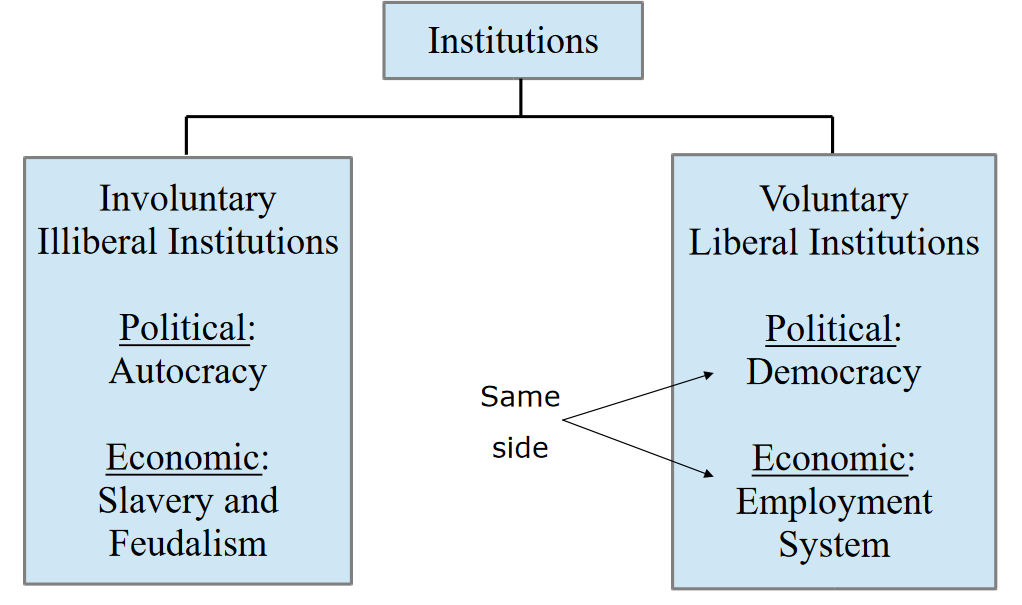 | 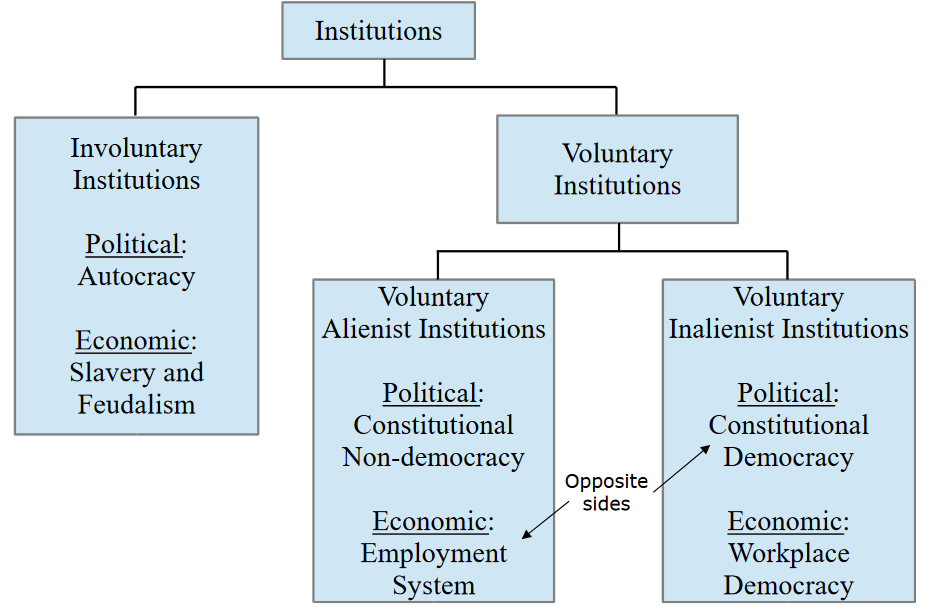 |
Long’s different, but related original:
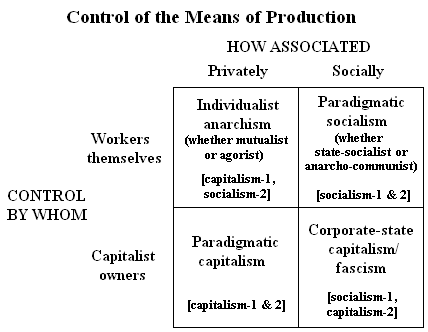
The whole capitalism-vs-socialism debate is misframed, the way an antebellum debate about “private vs public ownership of slaves” would be misframed. Both sides, even Marx, accept that the employment relation — renting human beings — is fine, and just argue over who should own the capital that does the renting (private shareholders or the state). Ellerman’s real target is the employment contract itself, on the grounds that human responsibility and agency aren’t transferable the way property is. You can rent a tractor; you can’t actually rent a person, you can only set up a legal fiction that pretends you can. Hence: workplace democracy / worker cooperatives as the actual alternative, with Marx as an “inadvertent capitalist tool” because he kept the debate stuck inside the wrong frame. Where we now stand Marx is doing more harm than good because he’s a god that is hard to kill because the frame is ubiquitous, partly because of him as well as his capitalist cohorts reinforcing the frame.
The “labor theory of property” (LTP) reframing is more defensible than the labor theory of value (LTV), and the inalienability argument (drawn from Hegel and the abolitionists) is harder to dismiss than standard exploitation talk or Marxist rhetoric (like, the “distribution” of…). LTP also explains something real — why “actually existing socialism” feels like state capitalism to anyone honest, and why the USSR/Maoist China ran labor camps with the same logic factory owners used, just with a different boss class. What the LTP-with-cost-limit price actually implies, taken seriously: prices stop being signals about willingness to pay and become signals about cost of production. Demand still exists — people want things in varying quantities — but it expresses itself through quantity adjustments rather than through price bidding. If demand exceeds supply at cost-price, you don’t raise the price; you either produce more, accept a queue, ration by some other principle (need, lottery, first-come), or let the demand go unmet. If supply exceeds demand, you produce less. The price stays anchored to cost. The LTP gives you a normative claim about who should own the output; the market gives you the actual price. The footnote about worker-owned firms still being “cost-plus” if they hire capital suggests the resolution — interest = overhead, no margin — more of an aspiration than a working mechanism. Mondragon doesn’t run that way. Neither does Emilia-Romagna. Whether any market system can run that way without something doing the work the price system currently does is the open question that mutualists have been arguing about with each other for 150 years. BUT Mutualists would argue the visible version of supply and demand with cost=price is actually better than capitalist markets because it forces the coordination problem into the open where it can be addressed by adjusting production, rather than hidden by letting the poor absorb the gap silently.
It’s roughly how a lot of things already work in non-market or quasi-market contexts: utilities under cost-of-service regulation, libraries, public roads, mutual aid networks, the internal economies of households and many cooperatives, healthcare in most of the developed world. In all of those, “what does it cost to provide” is doing the work that “what will the market bear” does in profit-driven exchange. So the question isn’t whether cost-based pricing can work — it demonstrably does in significant domains — it’s whether it can be the general coordination principle rather than an exception within a market system.
Ellerman is a worker-cooperative advocate, and that’s a real tradition (Mondragon, the kibbutzim, ESOPs) — but it has its own track record problems he doesn’t seem to engage with much. Co-ops can struggle with capital formation, scaling, and surviving market discipline (but that discipline is scale-tipping, as discussed below); the ones that thrive often do so in protected niches. The argument that the employment contract is categorically like a slavery contract because personhood is inalienable is philosophically interesting, if not sound, but doesn’t quite map onto how most people experience a job they can quit on two weeks’ notice. However, the experience is based on the frame we mostly live in, capitalism be damned, so it’s still an accurate map nonetheless.
My problem with Ellerman is that the state itself fails the inalienist test, not just the firm! If you can’t legitimately alienate your governing authority to an employer (because responsibility isn’t transferable), you also can’t legitimately alienate it to a government via some implicit social contract. Beyond the obvious issues of the “consent of the governed” being a huge problem on it’s face (Josiah Warren called ‘the consent of the governed the universal demolisher of government, not the builder of any…’), the classical pactum subjectionis — the supposed contract by which citizens hand sovereignty to a ruler — is structurally identical to the employment contract, just at a larger scale. Ellerman gestures at this but mostly stays focused on the workplace. If Ellerman is right about firms, he should be an anarchist, and the fact that he isn’t quite is a tension in the position. Further, Ellerman fails to see that rights are a figment of the imagination, or a human convention, or never says as much (but of course his entire angle is one of law as legitimate). Nonetheless, he gives reasoning against those that like to alienate, and I can’t thank him enough for pushing so hard on the misframing and goal to Abolish Human Rentals.
Ellerman’s whole argument rests on a fairly robust natural-rights claim: that personhood is factually inalienable, that a person literally cannot become a non-responsible instrument no matter what they sign. Alienist institutions are bad because they generate domination, not because they violate some cosmic right is a thinner foundation, but maybe a more honest one; it doesn’t require you to commit to inalienability as a metaphysical fact, just to treat de facto non-transferability as a useful diagnostic to calling bs on arrangements that alienate. Ellerman gets us out of the Lenin/Mao trap and out of the “shareholder capitalism is the only alternative” trap, but he leaves us with worker co-ops inside a more or less normal state.

The Leninist/Mao, shortcut is “seize The Flag, then remake everything from the top,” and plant The Flag in the hearts of humans killing them!? WTF?! Why not convert the flags one at a time, from the inside, and when enough have converted the system has changed without anyone needing a firing squad. Slower, less dramatic, but the failure modes are radically less catastrophic. A failed co-op closes. A failed revolution kills thousands/millions and installs the next batch of bosses.
Once you have co-op banks, co-op suppliers, co-op legal services, the friction for the next firm to convert drops. The flywheel is real but slow, and it has to fight against capital markets that are structurally hostile (you can’t IPO a co-op the normal way, raising outside equity is hard by design, etc.). The realistic path isn’t universal conversion, it’s a parallel sector that grows large enough to matter and to give workers a credible alternative. That doesn’t require everyone to convert, just enough that “go work at a co-op” or “convert your firm at succession” becomes a normal option. Most US small business owners are boomers approaching retirement with no succession plan — there’s a genuinely huge transfer-of-ownership window happening right now, and worker buyouts are one of the things that can fill it. Project Equity, the Democracy at Work Institute, a few state-level policies (Colorado, Massachusetts) are working that exact angle. It’s unsexy compared to revolution, which is partly why it might actually work.
A purely voluntarist path assumes the existing power structure will let itself be slowly eaten, and historically it sometimes does and sometimes doesn’t. That’s where the “non-violent” framing has to stay clear-eyed: non-violent doesn’t mean unopposed, it means you’re committed to losing fights you could only win by abandoning the principle. Which is the whole point — but worth naming, because the romance of the slow path can hide the fact that it’s still a fight.
David Ellerman, and Roderick T. Long have produced a plethora of good writing and thinking, including the items above, but I tweaked, merged, and expanded their graphics and ideas, including those of Gary Chartier and Charles Johnson:
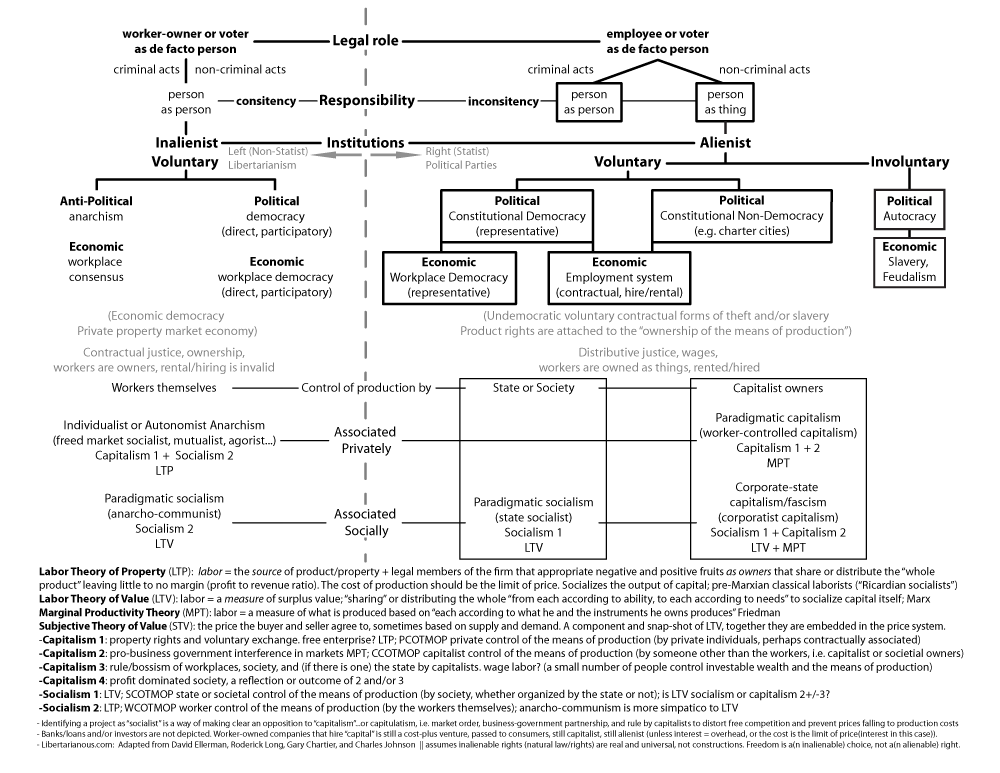
hi-res-PDF^Download As a single chart, it’s a remarkably compact statement of where I’ve been heading. It puts Lenin and the boss and the charter-city operator in adjacent boxes, and that’s the point.

Even a worker co-op that borrows from a conventional bank and pays interest above its actual cost of capital is reproducing the alienist structure at one remove — the surplus extraction just moves from the boss to the lender. To be fully inalienist, the cost of capital has to equal the actual cost of providing it, no margin. This is a much more radical position than mainstream co-op advocacy and lines up with mutualist/Tuckerite traditions that treat interest itself as a form of usury enabled by state-backed banking monopolies.
The mutualist tradition (Proudhon, Tucker, Carson) has actually thought about this for 150+ years and the answer is roughly: cost-price is sustainable in a freed market — one without state-enforced monopolies on land, credit, and intellectual property — because those monopolies are what currently allow prices to float above cost in the first place. Real cost in a freed market is much closer to actual cost of production than current prices reflect. Rent, interest, and IP licensing fees are the wedges that drive a gap between cost and price; remove the state-granted privileges that protect those wedges, and prices naturally tend toward cost without needing top-down enforcement. Carson’s Studies in Mutualist Political Economy makes this argument in detail. The market sets prices” isn’t a law of nature — it’s an artifact of specific legal arrangements (state-backed property in land, money-monopoly banking, IP) that the framework is also proposing to dismantle. Take those props away and cost-price isn’t a violation of economic reality, it’s what economic reality looks like when you stop subsidizing rent extraction.
Price-as-information sounds neutral when Hayek describes it, but the information it actually aggregates is willingness and ability to pay, which is not the same thing as need or even preference. A billionaire’s mild curiosity about a third yacht and a working family’s need for housing both show up as “demand” in the price signal, weighted by purchasing power. So the system isn’t really aggregating what people want — it’s aggregating what people want times how much money they have. That’s a specific and pretty distorted information channel masquerading as a neutral one. The “information” is already pre-filtered through the existing wealth distribution, which means the signal tells producers to make more of what rich people mildly prefer and less of what poor people desperately need. Calling that an information system is technically true but morally evasive.
In the current system, the entities that profit most from price information aren’t producers responding to it — they’re intermediaries who arbitrage it. Hedge funds, commodity speculators, market-makers, real estate flippers, pharmaceutical patent holders. These actors don’t produce the goods; they extract value from the price-discovery process itself. A genuinely informational system wouldn’t need or reward them. The fact that they’re so central to how the current system actually runs suggests price-as-information is partly a cover story for price-as-extraction-opportunity. Hayek’s argument about decentralized knowledge is bogus and getting used to justify a setup that mostly enriches people who add no knowledge and produce nothing.
Both the cost-the-limit-of-price, and capitalist systems require feedback loops. One loop’s failures look like waitlists and the occasional shortage. The other loop’s failures look like medical bankruptcy, housing crises, food deserts in poor neighborhoods next to grocery abundance in rich ones, and a financial sector that’s a third of GDP while producing roughly nothing. Pick your failure mode. The mutualist isn’t claiming theirs is failure-free; they’re claiming the failures are visible, addressable, and don’t require treating humans as acceptable losses.
The Classical Liberal framing falls short as Ellerman noted, but even Ellerman seems to not go far enough. Below is a remix considering Hohfeld:
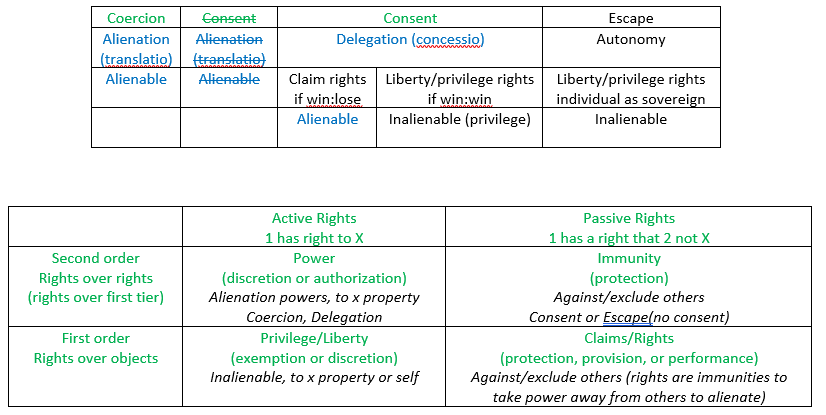
Passive rights are negative/immunity or positive/claim rights. Privileges and powers are not negative rights. Privileges, powers, and immunities are not positive rights.
Fundamental Legal Conceptions, As Applied in Judicial Reasoning and Other Legal Essays; Yale Law Journal, 23(1):16–59, Nov. 1913. Wesley Newcomb Hohfel
- “A right is one’s affirmative claim against another” [p55] (responsibilities, duties, obligations)
- “privilege is one’s freedom from the right or claim of another” [p55] [negative right or immunity?]
- “power is one’s affirmative ‘control’ over a given legal relation as against another” [p55]
- “immunity is one’s freedom from the legal power or ‘control’ of another as regards some legal relation” [p55]
- “A duty or a legal obligation is that which one ought or ought not to do. ‘Duty’ and ‘right’ are correlative terms. When a right is invaded, a duty is violated… a duty having a content or tenor precisely opposite to that of the privilege in question.” [p32]
- Full privilege/liberty rights, and no claim rights, would mean everything was permitted
- Full claim rights, and no privilege/liberty rights, would mean everything was prohibited or compulsory
- A claim right to privilege/liberty means people are indebted to respect others’ privilege/liberty
- Privileges and powers are not negative rights (entitled to non-interference)
- Privileges, powers, and immunities are not positive rights (entitled to provision of good/service, via duty of others)
- Negative rights are respected by refraining from interfering with others
- Fulfilling everyone’s positive rights may be difficult or impossible. This Mutual Exchange Radio Podcast with William Gillis on Positive and Negative Liberty is worth a listen. The basic premise of Gillis is that Positive Liberty is the cornerstone to a larger praxis that includes rights talk.
- rights in rem: real rights: negative/against the world at large to be left alone, proprietary (Hohfeld used “multital”)
- rights in personam: personal rights: positive, contracts (Hohfeld used “paucital”- right duty limited circumstance and people); privileges, some immunities
- jus ad rem: right/s transfer

What is, or rather ought, to be permitted, required, or forbidden? Who decides the is vs. ought is a freedom vs. license/permission/rights question. “Rights are an ought border; liberty is a borderless is.” EMN
Natural law proponents must answer why laws, if natural and universal, are often a dilemma of self-interest vs. the interest of others, including that of the rule makers?
Why focus on “rights talk” as it shifts the focus to right holders, not those stuck with the obligations or oughts/responsibilities? As Marx pointed out, the rights holder is an “isolated monad…withdrawn behind his private interests and whims and separated from the community.” (Marx 1844, 146) Sad as it is, we have a system where rights are needed unless simplified to “stay out of my business” (and by default the business of others), but we are often in other’s business as we are not me, or me’s must interact unless totally cut off from we, or society for that matter.
Regretfully, most of the freedoms we have were fought for, not handed to us, because the State is not much different than feudalism and bureaucratic nobility protecting their interests. Rights can create confrontations by inhibiting dialogue or negotiation because rights can become a trump card (or series of trump cards) to stop discussion that might lead to consensus, accommodation, common ground, and liberty for that matter. The communitarian view is that rights should not be trump cards, but cards for playing and building with other selves and recognizing that other selves have needs and rights claims that vary in cultural contexts. This isn’t to stay communitarianism is the answer, but it’s not as though most people can’t agree with this view. We are stuck with politics in the end, which seems to be a system of rigging trump cards to favor the ruling class.
Is anarchism’s anti-politics and the “chaos” of many paths, with one vision that accepts there are many paths, an answer? Or if you like, is contingency (in the sense of Richard Rorty) agency, in other words, is the power to action based on the truths we hold/think be true? How can you answer no, how can you deny anarchism?
Paths, or paths to resources (or more than one vision), can sometimes lead to conflict or rivalry as there is no coordination/cooperation. (elaboration and game theory problems to be discussed in a forthcoming piece…). As Gillis (in the podcast above) and others have pointed out, States claim to solve, or be a solution to, the coordination problem, but in practice they create a coercion problem.
…under capitalism, “individual private property” for most actual individuals is nothing more than a right to work with the means of production owned by someone else, and to spend every living moment in a space owned by someone else..[in our defense] common access rights and the irreducible minimum* constitute negative freedom against the arbitrary authority and coercion of landlord or employer. [Whether abolishing human rentals will help on this front remains to be seen.] Kevin Carson, Hayek’s Fatal Conceit
*Hunter-gatherer bands and stateless agrarian villages had solidarity-based economies characterized by usufructory property rights and mutual aid — along with what Murray Bookchin, borrowing from Paul Radin, called the “irreducible minimum”: “the shared notion that all members of a community are entitled to the means of life, irrespective of the amount of work they perform. To deny anyone food, shelter, and the basic means of life because of infirmities or even frivolous behavior would have been seen as a heinous denial of the very right to live. Nor were the resources and things needed to sustain the community ever completely privately owned: overriding individualistic control was the broader principle of usufruct-the notion that the means of life that were not being used by one group could be used, as need be, by another.”28 And such social models based on usufruct and the irreducible minimum persisted in many places even under class and state rule — for example in Bengal until it was stamped out by Warren Hastings, in East Africa until destroyed by British colonial authorities, and in the Russian Mir until suppressed first by Stolypin and then by Stalin. Kevin Carson, Hayek’s Fatal Conceit

Where Ellerman could go wrong. If you push inalienability hard as a rights claim, you end up with a kind of hyper-individualist position that says “no contract can ever transfer my agency, full stop” — which gets you anarchism but can get you the same monadic isolation Marx complained about. The Hohfeld-plus-communitarian remix says: yes, agency is non-transferable as a fact about persons, but the conclusion isn’t “I am sovereign and untouchable,” it’s “we have to actually negotiate with each other as agents, repeatedly, without one party permanently subordinating the other.” That’s a more livable position. It’s closer to what an actual co-op or an actual healthy community does — not “I have rights you can’t violate,” but “we keep doing the work of being in relation, and no one gets to opt out of that work by buying or selling their way out of it.”
The abolition analogy is genuinely the strongest part of Ellerman’s framework, because it’s the one historical case where something that looked economically permanent and morally normal to most people became unthinkable within a couple of generations. Nobody in 1820 could imagine the cotton economy without slaves; by 1870 nobody could imagine it with them. The shift wasn’t primarily economic — it was a legitimacy collapse, and the economic adjustments followed.
So the model isn’t “co-ops slowly outcompete,” it’s “co-ops exist as proof of concept while the moral frame shifts, and once the frame shifts the legal structure follows fast.” That’s a real pattern. Slavery, monarchy, coverture, child labor, dueling — all looked load-bearing until they didn’t. The legal abolition was usually the trailing indicator, not the cause. Chattel slavery had a visible victim class with an obvious moral asymmetry that, once people stopped looking away, was hard to un-see. Wage labor is murkier because most people experience their job as a deal they took, not a violation done to them — even when it’s exploitative, the phenomenology is “I chose this.” The inalienability argument says that intuition is wrong, you can’t actually consent to becoming a non-responsible instrument any more than you could consent to being property — but the felt experience is different in a way that matters for how a legitimacy shift would actually propagate. Slavery had a moment where the country couldn’t keep telling itself the lie. Wage labor doesn’t have an obvious equivalent moment, which is why the path is probably longer and weirder than abolition was.
The thing that might function as the legitimacy crack is something more like what’s already happening: AI and automation forcing the question of what work is for, gig economy stripping the fig leaf off the “you’re just an independent contractor” framing, the gradual realization that “shareholder primacy” is an invented and recent doctrine rather than a natural law. None of those are abolitionist moments on their own, but they’re the kind of slow erosion that eventually leaves the structure standing on nothing. Then a generation grows up that finds the whole arrangement weird, and the legal change is the formality at the end. Whether that takes 30 years or 300 is the open question.
Ellerman gives the inalienist axiom and applies it cleanly to the firm. The Long/Chartier/Johnson extension applies it to the state. The Hohfeld remix gives you the analytical tools to talk about it without collapsing into rights-talk’s worst tendencies. And the Carson/Bookchin material gives you the historical evidence that humans have actually lived this way at scale, repeatedly, until specific historical actors stamped it out. That’s not a complete program, but it’s a coherent diagnosis and a defensible direction. The rest is up to us.
The leap from “this works in bands, villages, and the mir” to “this can work for eight billion people who need to coordinate on climate, pandemics, and supply chains” is still the unresolved question, but what the hell do we have to lose, driving down the same road to feudalism or down a new fork or paradigm?
Transitions cost real people real things, and the people who pay aren’t usually the ones who designed the transition. That’s not a reason not to transition — staying put also costs people things, and probably more — but it’s a reason to take the how seriously, not just the whether. The strongest version of the slow-fork path is exactly: build it from below, prove it works in increments, let conversion happen voluntarily as the legitimacy of the old form erodes. That keeps the cost of being wrong low. The Leninist version maximizes the cost of being wrong, and the historical record shows what that looks like. f*ck that.
Keep doing what’s clearly not working and hope it stops not working? It’s not a hard choice. The hard part is just having the patience for it, and not getting talked out of it by people who’ll insist the only alternative to the current arrangement is the one with the gulags, a Mao and Lennist false binary. And the whole inalienist framework is built to break that bullshit and call out Marx as a capitalist tool. No Gods, No Masters. Not Marx, not Ellerman, NO ONE. Marxism feels like a privileged Vanguard ready to plant The Flag, sometimes directly in another human’s heart as collateral damage rather than handing them a flag of their own and telling them, “I love you as family and we should all be on those terms” — fraternity, agape, ubuntu, or just basic decency. Politics, or political traditions in general tend to trend to go bad, and the political Vanguard decides some category of people falls outside the family for the duration of the project. That’s the move that lets a Lenin order the Tambov gassing or a Mao let 30 million starve — they’ve defined a class of person whose heart is acceptable terrain for the flag.
Renting humans and asking for cost plus above overhead just seems archaic anymore, hard to unreason or unsee. The employment relation stops looking like the natural shape of work and starts looking like a particular historical arrangement that requires a specific legal fiction to function. You don’t have to be a co-op evangelist to find that arrangement increasingly hard to defend on its own terms. There is no certainty about what replaces capitalism, but a clarity that the current setup isn’t the end of the story, and a refusal to accept either the Leninist’s flag or the shareholder’s as the only options on offer is critical. A third path, even if it’s slow and uncertain, is still a path worth trying more than the road of serfdom and alienation.

Markets in their current form require enormous, ongoing state enforcement — property law, contract law, IP, the entire financial regulatory apparatus, central banks, courts, police protecting warehouses. They’re not the absence of imposed structure; they’re a specific imposed structure that’s been around long enough to feel like weather. The alternative isn’t “imposed system replaces natural system,” it’s “differently imposed system replaces currently imposed system.” Once that’s clear, the question becomes which imposition you’d rather live under, and that’s a values question, not a physics question. And on values, “humanistic vs parasitic” names what the current arrangement actually does rather than what it claims to do. The world stops looking like weather and starts looking like architecture, and architecture has architects, and architects had reasons, and the reasons mostly weren’t about you.
People who use the tools of thinking selectively, against the systems they dislike but not against their own preferred replacements, end up as ideologues. People who use them all the way down end up full of more questions than answers, clearer about what’s broken than about what would fix it, suspicious of any framework that promises to resolve the suspicion. That’s not a failure of the skeptic/rationalist toolkit; it’s what honest use of the toolkit produces. Certainty is mostly available to people who stopped thinking early. Never totally sure is science, using questions correctly. When someone is totally sure, it’s a warning sign. Anyone fully convinced they have the answer for eight billion people has either solved philosophy or stopped doing it. Mostly the latter.
Disbelief is sustainable; anger corrodes if it doesn’t have somewhere to go. The systems we’re angry at were built over centuries by people mostly long dead, and the current beneficiaries are often just running the program rather than maintaining it consciously. You can’t really get even with architecture. What you can do is refuse to add to it — refuse to apologize for refusing to apologize, refuse to launder cruelty through abstraction, refuse to hand someone a flag-shaped object pointed at another human’s heart. That’s small, but it’s real, and it’s the part that’s actually in your hands.
The rest — the systems, the scale, the eight billion people — those aren’t yours alone to fix and were never going to be. Carrying them as if they were is how clear-eyed people end up bitter or burned out or convinced they need to seize a flag of their own. The Ellermans and Carsons and Bookchins of the world did their part by handing you a new frame; your part is smaller and more local and probably has more to do with how you treat your partner, friends, and the few people actually in range than with whether worker co-ops scale. Which sounds like a deflation but isn’t — it’s just where the leverage actually is for any one person, including the ones who pretend otherwise. The discomfort and anger at the system is the cost of seeing, and I’ve decided I’d rather pay it than not see.