
Method Without Foundations ended with values named as starting points, deduced from nothing. They still have to be said in words, and moral words are slippery. Most of them do two jobs at once: they describe something, and they press for something. Many quarrels in ethics are one word doing one job in one mouth and the other job in the next. This page takes four of those words, happiness, selfishness, objective and free, and then the one these pages lean on hardest, respect. Its claim is modest on purpose. Agency is the best reason for respect anyone has found. It is not a proof, and the page says why the difference matters.
Two meanings of happiness
In 2009 Alex Strekal, writing as brainpolice, noticed that two words cause much of the trouble in arguments about ethics: happiness and selfishness. Each carries two meanings. One is psychological, the one everyone uses. The other is a term of art inside a particular moral theory, and the theory’s defenders and critics keep talking past each other because each hears a different word.
Take happiness. Virtue ethicists from Aristotle on put it at the center of ethics, but what they mean is closer to flourishing, a life going well, than to a pleasant feeling. Aristotle’s word, eudaimonia, never meant a mood. Critics hear the everyday sense and object at once: a murderer can be happy, so happiness can’t be the test of right. The virtue ethicist then has to explain the other meaning, or fall back on a false claim, that wrongdoers are always secretly miserable. Common experience refutes that. Some cruel people sleep well and some decent people don’t.
Strekal’s fix was to make the claim smaller and true. Decency may be needed for a good life without being enough for one, the way liberty is needed for flourishing and guarantees none of it. Liberty is not freedom from the limits of reality. Someone can be free and miserable.
Two meanings of selfishness
Selfishness has the same split, run the other way. Ayn Rand was right, Strekal granted, that an ethics cut off from self-interest goes badly wrong. But in The Virtue of Selfishness she made the opposite mistake. She defined selfishness so that it means rational, and rational so that it means moral. On those terms a thief who takes what he wants is not being selfish, which no ordinary speaker would accept. Against her stands the psychological egoist, for whom every motive is selfish because every motive is someone’s own. Then the word sorts nothing, since the saint and the thief are equally selfish.
The point reaches past Rand. A word with a private meaning wins arguments it shouldn’t, because it can slide between senses in the middle of a sentence. That is equivocation: calling what a state imposes “order,” and its absence “chaos,” is the slide Order Without a Master Plan starts from. Libertarian” slides too. In philosophy a libertarian is someone who holds that we can act outside the chain of causes, and that is where the word began, before either political sense, as The Origins of the Word “Libertarian” tells. Strekal’s rule is the one to keep. Say which sense you mean before you lean on it, or drop the word.
Asking what a word means has a counterfeit. Put “Do you believe in God?” to Jordan Peterson and he will ask what you mean by “do,” “you,” “believe” and “God,” and a plain answer rarely follows. It is Bill Clinton’s “It depends upon what the meaning of the word ‘is’ is” with a reading list. Pressed further, he often changes the subject, a red herring, then knocks down a weaker version of the question, a straw man, in language vague enough to fit either side. He equivocates too, most famously on “true,” which in his 2017 and 2018 debates with Sam Harris slid between “factually correct” and “useful for survival.” And he pleads a special case, letting the stories he favors count as true in the second sense while holding his opponents to the first. Asking which sense is meant is honest when an answer comes after it. Asked without end, it is evasion dressed as rigor, because a claim that never settles on a meaning can never be checked. The pull is general, not his alone: everyone scrutinizes the claims they dislike harder than the ones they like, which psychologists call motivated reasoning. Peterson is simply a famous case of letting it run the conversation.
Free will, or a will of one’s own
The third word, free, carries the most weight and the most confusion. In Free Will (2012) the neuroscientist Sam Harris argued that free will is an illusion. We are physical beings, and our choices come from brain states we didn’t choose. An immaterial soul, if we had one, would leave us no freer. Philosophers sort the replies three ways. Libertarians, in the free-will sense, say we could have done otherwise and so stand outside the chain of causes. Hard determinists say we couldn’t, and that chance wouldn’t help, since a random choice is no more ours than a caused one. Compatibilists say freedom never meant escaping causes. It meant acting from your own reasons without someone else’s hand on the controls.
The physicist Victor Stenger took the last road in Skeptic (2012). Quantum chance is real, he argued, but the brain works at a scale where it washes out, so physics offers no exit from causation. What remains is what he called autonomous will: choices made inside a person, by that person’s own brain, history and reasons, rather than imposed from outside. You can’t step outside the causes, and you don’t need to. A choice is yours when it runs through you.
That is all the agency we need. The question it asks of an arrangement was never whether people float free of causes. It is whether their acting is their own or is being run by someone else, whether they are agents or inputs. Determinism doesn’t erase that difference. A person shoved by another’s hand and a person moved by her own reasons are both caused, and only one is being used. Harris’s own conclusion points the same way: if no one authored themselves, punishment built on vengeance loses its excuse, and what is left is protection and repair. Many of the offenses people are jailed for lose theirs too: where no one was harmed, there is no one to protect and nothing to repair. The Door That Stays Open adds David Ellerman’s point that responsibility for your own acts can’t in fact be handed to someone else. Whatever the metaphysics, that is the fact the floor stands on.

Agency, respect, solidarity
The Introduction says it in two sentences: “We can choose to put respect for human beings at the center. That is humanism.” Humanism here means a practice, from below, with no vanguard, and this page can say what it rests on. Agency is the ground, respect the principle, solidarity the practice.
Anyone who acts claims room to act. You can’t pursue anything without treating your own freedom and well-being as worth having. If that claim matters when it is yours, consistency says it matters when it is someone else’s, for the same reason. That is Robert Ingersoll’s rule with the reason underneath it, and William Gillis’s “your freedom is my freedom.” The respect it yields is the floor in What Rights Are: no one may be used as an input. And agency isn’t solitary. People become able to act through others, and can do more together than apart, so agency needs respect to be safe and solidarity to grow. Respect is the floor. Solidarity is the reach: standing with people, mutual aid, the co-ops and commons people already build without a ruler.
Agency also comes in degrees, and it isn’t only human. A dog that wants out, a crow working a puzzle, a child too young to sign anything are all acting, more or less. Respect follows agency wherever it is found, in proportion to it. That answers the worry that humanism is species loyalty in better clothes. The line is drawn by what a being can do, not by what species it belongs to.
Here the caution from Method Without Foundations applies in full. Alan Gewirth tried to turn this argument into a proof. In Reason and Morality (1978) he argued that every agent must, on pain of contradiction, claim rights to freedom and well-being, and so must grant them to every other agent. He even held that partial agents, children and animals among them, are owed rights in proportion to their agency. Critics, Bernard Williams among them, found the weak joint. An agent has to want her own freedom, but nothing forces her to call that want a right others must honor. The step from my claim to yours binds only someone who already cares about consistency, and a determined egoist can decline it, as Max Stirner did. So I don’t offer the argument as a proof. It is the best reason for respect anyone has given, open to the next criticism like everything else here. A reason is something you offer a person who might be persuaded. A proof would be something to enforce, which is of no use.
No final vocabulary
Richard Rorty is good company for that last point, taken with care. In Contingency, Irony, and Solidarity (1989) he argued that no one has a final vocabulary, a set of words that settles moral questions from outside every point of view. We act on truths we can’t prove. The honest person, his ironist, knows it and acts anyway. Solidarity, for him, isn’t found in a shared human essence. It is made, by coming to see more and more kinds of people as one of us, mostly through stories that show how they suffer. He took his definition of a liberal from Judith Shklar: someone who thinks cruelty is the worst thing we do. There is an irony here too. Age is often blamed for closed minds, yet it usually brings more encounters with more kinds of people, and with them the perspective we call wisdom. The circle of “us” widens by meeting people, and by our own aches and suffering as the years add them, which teach what others feel. Stories are not the only way in.
The care is needed because Rorty is easy to misread in both directions. He wasn’t saying anything goes. He was saying the reasons stop short of bedrock, which is what the Introduction’s trilemma says too. And he was no anarchist. He was a social democrat who thought the institutions of liberal states the best hope going. I take the idea and leave the politics. Grant that our deepest commitments are contingent, and the defender of rulers loses the bedrock he claimed too. If no vocabulary is final, neither is the one in which some people are born to command. That turns the question around. I once asked it this way: if acting on the truths we hold is agency, how can you answer no, how can you deny anarchism? It is a challenge, not a proof. A ruler’s case has to be made in the open like any other, and it has never been made well. Whether it ever could be stays open, as every question must here. My bet is that it can’t.
A map of the answers
We can map the philosophies or answers to “what is morality?” into trees, and the four charts below draw them. The first sets out the questions that divide the views. Can moral claims be true or false at all? Are any of them true? Does their truth depend on anyone’s attitudes or choices? If not, are moral properties natural ones? The other three charts are close-ups of its branches, and each box names a thinker or two to follow up.
The shaded boxes mark where this site leans: constructivism and value pluralism on the question of what morality is, and consequences that count only within side-constraints on the question of how to act. The lean is shown so no one has to guess it. The arguments on these pages are built not to hang on it.
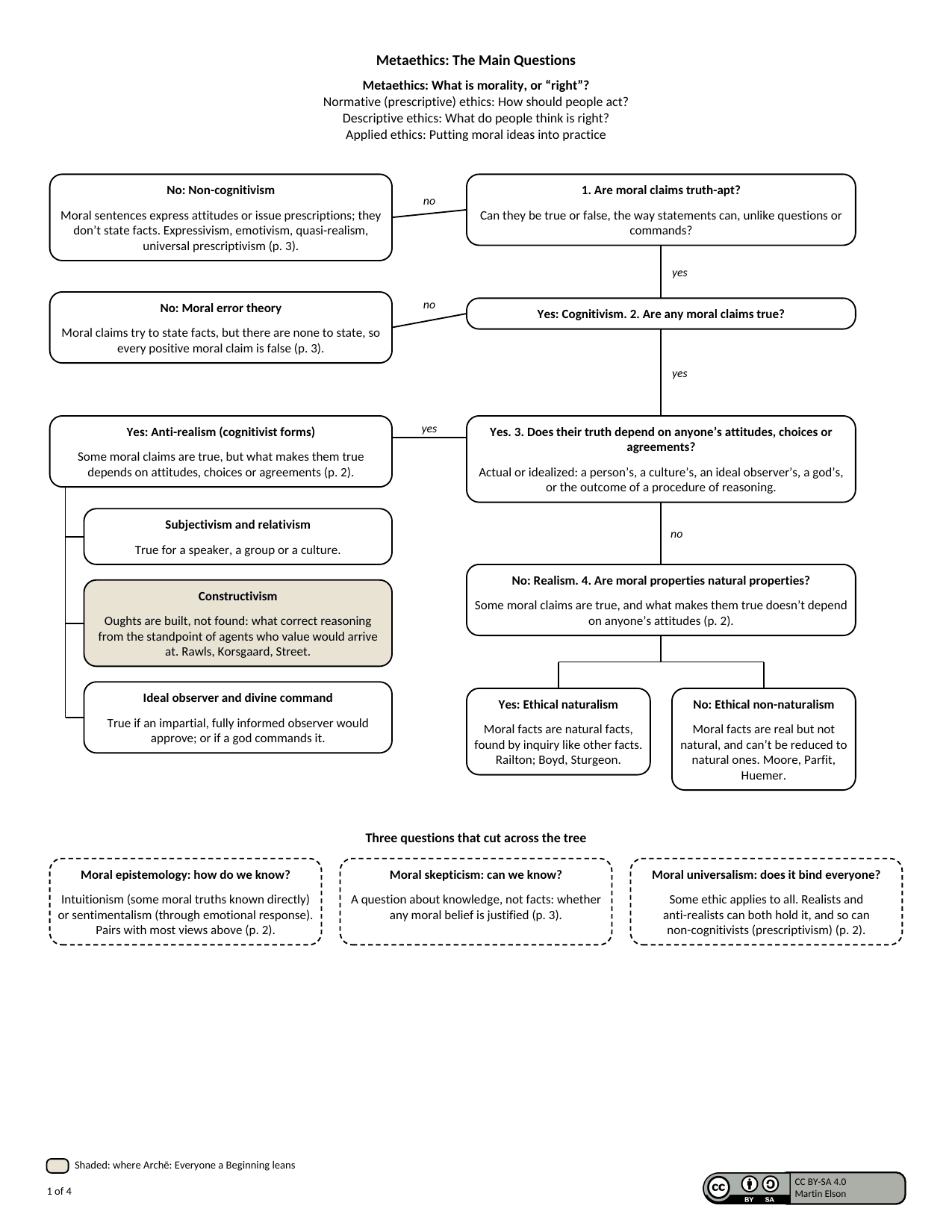
Figure 1. The main questions: four yes-or-no questions, with every view on the later charts hanging off one answer. A band at the foot shows three questions that cut across the tree: how we know, whether we can know, and whether morality binds everyone.
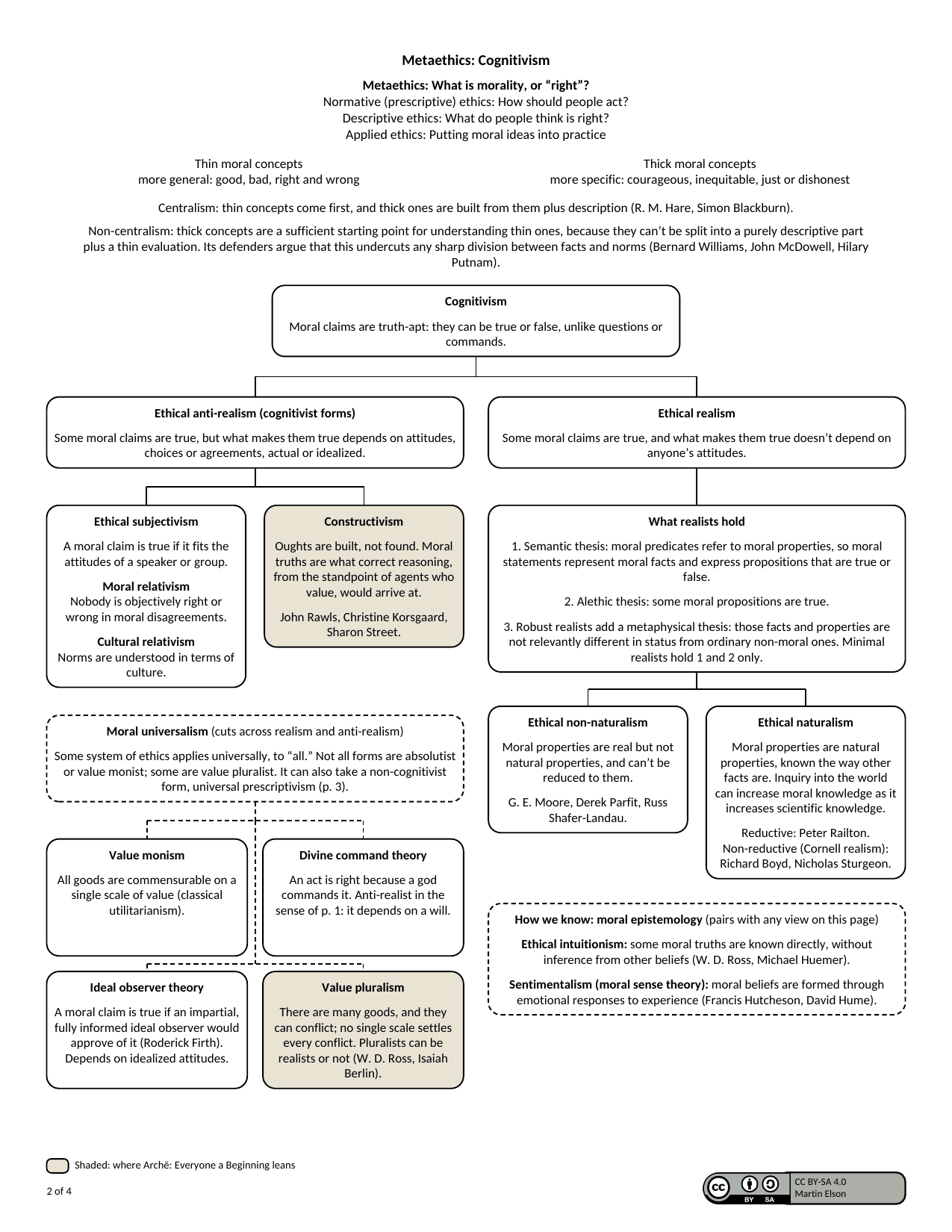
Figure 2. Cognitivism: views on which moral claims can be true. Realism, natural and non-natural, against the anti-realist forms, subjectivism and constructivism. Constructivism and value pluralism are shaded.
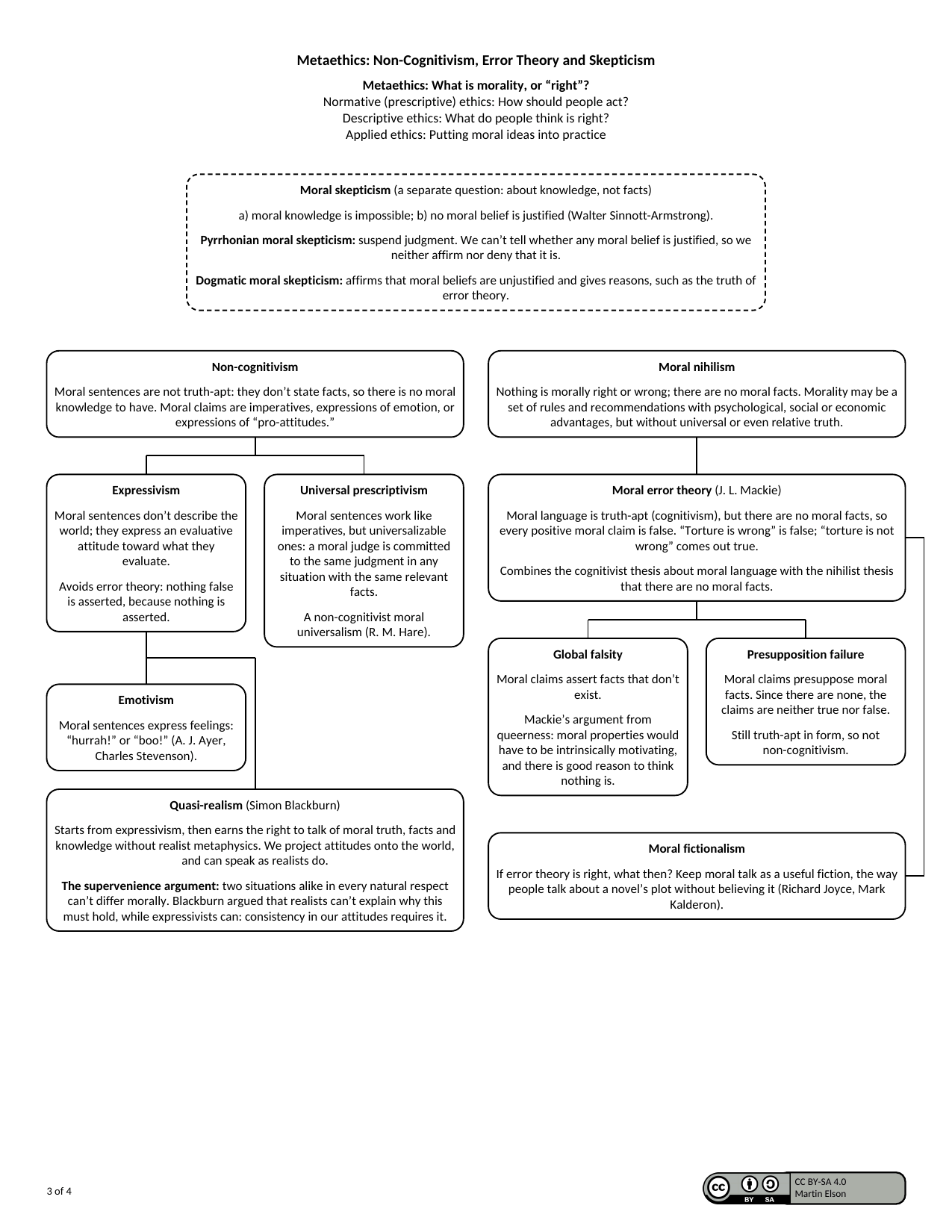
Figure 3. Non-cognitivism, error theory and skepticism: expressivism and its kin, Mackie’s error theory, fictionalism, and skepticism as a question about knowledge.
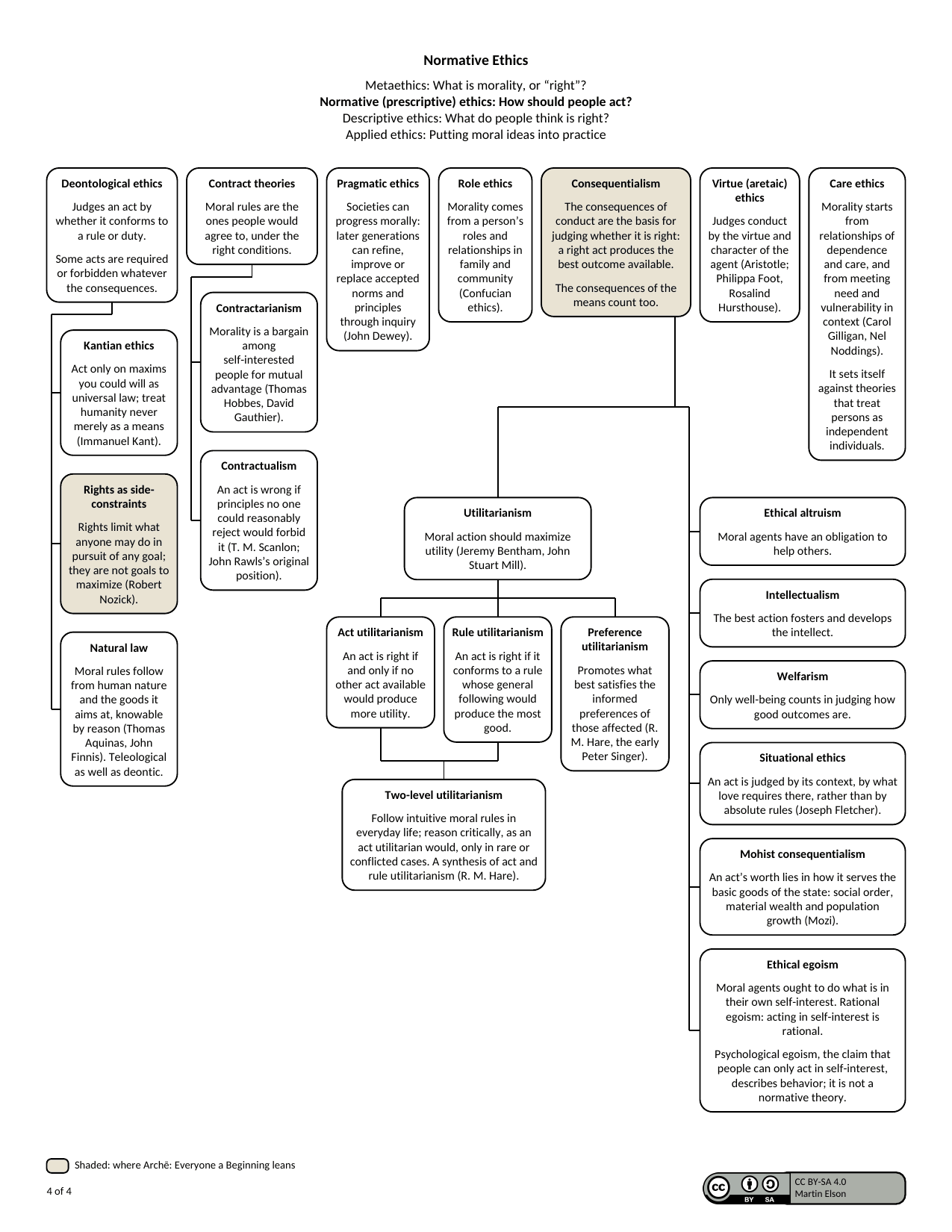
Figure 4. Normative ethics: how should people act? Consequentialist, deontological, virtue, contract and natural-law theories. Consequentialism and rights as side-constraints are shaded together.
All four charts as one PDF: download (CC BY-SA 4.0, Martin Elson)
The strongest case against
The first thing most people ask about questions like these is whether moral truths are objective, true whatever anyone thinks, or subjective, reports of what someone feels. William James offered a way to test quarrels like that. If nothing anyone could observe or do would come out differently whichever side is right, the dispute is idle. A good deal of this one is. Whichever side is right, the claim that someone was used as an input gets checked the same way, against what was actually done. That most people don’t want to be robbed is a fact. That their not wanting it should count is a starting point, and the Introduction keeps the two apart on purpose. One side of the quarrel insists the difference is anything but idle, and it deserves its best hearing.
The strongest objection comes from the moral realist, and Rorty handed it over himself. If moral words are tools and not reports, then “slavery is wrong” is a feature of our vocabulary. The slaveholder had a different one, and nothing makes ours better except that we won. Rorty admitted his ironist has no argument that would move someone who doesn’t share her hopes. A realist calls that a confession of defeat. Some things are wrong whether anyone agrees or not, the realist says, and an ethics that can’t say so has given away the one thing ethics is for.
The objection is right about what is at stake and wrong about what the realist has in hand. Saying it is an objective fact that slavery is wrong doesn’t move the slaveholder either. He had facts of his own, from natural law and from scripture. What ended slavery was people refusing, organizing and changing what others could bear to see, the work Rorty credits to stories and I credit to solidarity. None of this reduces “wrong” to taste. A moral claim here joins a named starting point to checkable facts: whether a person was used as an input, whether they could say no and leave. The facts can be argued over and the starting point is in the open. The realist’s bedrock is one more axiom, and the Introduction asks of every axiom whether its holder would keep it when it cut against them.
So I am sure of the floor and unsure of what finally grounds it. It holds the floor the way Popper held truth: as something to get right, with no proof of having got it, kept firm by consistency and open to the next criticism.
Black Uhuru put it more simply, on their 1984 album Anthem: “Solidarity”, a song by Little Steven Van Zandt.
Where this lands
Moral words do two jobs, and most confusion comes from letting them switch jobs mid-argument. Happiness and selfishness need a stated sense or nothing. Whether ethics is objective matters less than whether its claims are checked. Freedom from causes is not what anyone needs; a will of one’s own is, and the difference between an agent and an input survives any physics. Agency is the ground, respect the principle and solidarity the practice. That is the best reason for respect on offer, not a proof, and it reaches wherever agency does. Method Without Foundations says how these values are held. What Rights Are says what the floor protects.
Sources
- Alex Strekal (as brainpolice), “Terminology In Moral Discourse” (Polycentric Order, May 2009). The two meanings of happiness and selfishness. archived · copy here
- “Absolutes” (LessGovernment.com, by Eugene; reposted here December 2012). Replaced by this page; its point is James’s. original · copy here
- William James, Pragmatism: A New Name for Some Old Ways of Thinking (Longmans, Green, 1907), lecture 2, “What Pragmatism Means.” A difference that makes no difference is no difference; after C. S. Peirce, “How to Make Our Ideas Clear” (1878).
- Aristotle, Nicomachean Ethics, book 1. Eudaimonia as a life going well.
- Ayn Rand, The Virtue of Selfishness (Signet, 1964). Selfishness defined as rational and moral.
- Sam Harris, Free Will (Free Press, 2012). Free will as an illusion; the case against retributive punishment.
- Victor J. Stenger, “Free Will and Autonomous Will” (Skeptic 17, no. 4, 2012), pp. 15–19. No quantum exit from causation; autonomous will. Skeptic
- Robert Kane, A Contemporary Introduction to Free Will (Oxford University Press, 2005). The map of positions Stenger uses.
- Alan Gewirth, Reason and Morality (University of Chicago Press, 1978). The Principle of Generic Consistency; rights in proportion to agency.
- Bernard Williams, Ethics and the Limits of Philosophy (Harvard University Press, 1985), ch. 4. The gap between wanting one’s freedom and claiming a right to it.
- Max Stirner, The Ego and Its Own (1844). The egoist who declines the step.
- Robert G. Ingersoll, “The Liberty of Man, Woman and Child” (1877). Give every other human being every right you claim.
- William Gillis, “Your Freedom Is My Freedom: The Premise of Anarchism” (Human Iterations, 2017). original
- Richard Rorty, Contingency, Irony, and Solidarity (Cambridge University Press, 1989). No final vocabulary; the ironist; solidarity made, not found. His politics: Achieving Our Country (Harvard University Press, 1998).
- Judith N. Shklar, Ordinary Vices (Harvard University Press, 1984). Putting cruelty first.