
Governments derive their just powers from the consent of the governed. The Declaration of Independence says so, and nearly every modern state claims the same pedigree. Take the sentence at its word and it asks a question no state can answer: who consented, when, and to what? This site already uses one test for the firm. Authority may be lent to someone who answers to you; it can’t be sold. This page applies the same test to the state. The state fails it, and its sharpest defenders have known that for centuries.
The case for consent
John Locke gave the theory its classic shape. People are born free and equal, and no one can be put under another’s political power without his own consent. Consent can be express or tacit. Express consent makes you a member of the commonwealth. Tacit consent is lighter: anyone who owns land, lodges for a week, or even travels freely on the highway inside a government’s territory has, Locke says, agreed to obey its laws while there. It looks thin, but Locke had a reason. He wanted government to rest on the people rather than on God or conquest, and he needed a consent ordinary people could be said to have given.
Modern defenders know tacit consent is weak and offer three replacements. The first is fair play. H. L. A. Hart and John Rawls argued that whoever takes part in a cooperative scheme and accepts its benefits owes a share of its burdens, and George Klosko extended the argument to goods no one can do without, such as defense and public order. You can refuse to sign, but you can’t refuse to be protected, and taking the protection binds you. The second is hypothetical consent: what counts is not what you agreed to but what any reasonable person would agree to, which is how Rawls frames justice itself. The third, and the most careful, is David Estlund’s normative consent. If you would be wrong to refuse a just arrangement, he argues, your refusal doesn’t count, and you are bound as if you had agreed. Others point to acts instead of words, and say that voting, paying taxes and taking an oath show consent in deed, though the taxes, at least, were never optional.
Behind all of them is a fair worry. Without some kind of consent, government rests on force alone, and history shows how that goes. Consent theory is the attempt to tame power by tying it to the people it rules. The aim is right. The question is whether the tie holds.
Where it goes wrong
The contract of subjection. The old theory had two contracts. Samuel Pufendorf called the first the pactum unionis, by which people form a society, and the second the pactum subjectionis, by which the society submits to a ruler. Look closely at the second. One party hands the governing of its own acts to another and keeps no right to call it back. That is the shape of the employment contract at the scale of a country, and Hugo Grotius drew the line himself: if a man may sell himself into slavery, he asked, why may a people not hand its sovereignty to a king and keep nothing back? Thomas Hobbes made the fiction explicit. Each subject owns himself the author of whatever the sovereign does, so whatever the sovereign does, the subject did. One person’s acts are counted as another’s. It is the same fiction that sits inside the employment contract, and it can’t be made true by signing.
Lent or sold. Medieval lawyers asked the same question of the Roman people and their emperor: had the people’s authority been sold or only lent, translatio or concessio? Property Without Propertarianism tells that story. The point here is that Locke, for all his liberalism, chose sale. Express consent, he wrote, binds a man “perpetually and indispensably”; he can never again leave unless the government itself dissolves. Only tacit consent lets you walk away, and then only by giving up your land and quitting the country. The liberal state inherited the contract of subjection on gentler terms, not a different kind of contract. If responsibility for your own acts can’t be sold to a boss, it can’t be sold to a ruler, or to a so-called representative either, and whoever claims the sale holds a void title.
The constitution no one signed. Lysander Spooner took tacit consent apart in 1870. The Constitution, he observed, was never signed by anyone, and a contract no one signed binds no one. Voting proves nothing either. The ballot is secret, so no representative can know who his principals are, and an agent who can’t name his principals is no one’s agent. Most people never voted for him anyway. And a man who votes may only be defending himself. Forced into a contest he never chose, he uses the one weapon left to him, the way a conscript fires in a battle he didn’t start. The ballot, Spooner wrote, is “a mere substitute for a bullet.” Malcolm X drew the same pairing in 1964, in “The Ballot or the Bullet”: if the vote would not answer, the other means of defense remained.
Ratified by whom? The founding shows the same gap. The Articles of Confederation could be changed only if every state legislature agreed. The Philadelphia convention, called to revise them, wrote a new constitution instead, to take effect once nine state conventions ratified it, and so set the Articles’ own rule aside. The Anti-Federalists saw what that meant. At Virginia’s ratifying convention Patrick Henry asked who had authorized the delegates “to speak the language of, We, the people, instead of, We, the states?” Rhode Island refused to call a convention, voted the Constitution down in a 1788 referendum, and ratified in 1790, by two votes, only after the new Senate passed a bill to cut off its trade. Federalists and Anti-Federalists argued over who had consented, the people or the states. Both took the consent itself as given. Spooner’s point is that no one ever gave it.
Locke’s highway fares no better. David Hume asked whether a poor peasant or artisan, who knows no foreign language and lives on daily wages, has a free choice to leave his country. We might as well say, he wrote, that a man consents to the captain’s rule by staying aboard a ship he was carried onto asleep, when leaving means leaping into the ocean. Today the ocean is fenced. Every habitable acre is claimed by some state, and the United States taxes its citizens wherever they live and charges some of those who renounce an exit tax on the way out. There is nowhere to take tacit consent back to.
You can’t consent if you can’t refuse. Charles Johnson turned these points into one argument. Consent is a choice, so there must be something that would count as refusing. And consent is a relation between two parties, so the other party must be willing to honor the refusal; Johnson calls this the opt-out principle. A state taxes and commands voters and non-voters, patriots and dissenters alike. No refusal you could make would change what it does to you, so nothing you do can count as opting in either. That holds even for the sincere patriot who wants to consent. She can’t, because the state has taken the question off the table. If governments derive their just powers from the consent of the governed, Johnson concludes, no existing government has any.
Fair play, hypotheticals and a duty to agree. The modern replacements fail the same test. Robert Nozick answered fair play with a public address system. If your neighbors set one up to entertain the street, enjoying it doesn’t oblige you to take a day at the microphone. Benefits pressed on you don’t bind you, and the state’s are pressed on everyone. Klosko’s indispensable goods show that people need defense and order, not that they need this supplier, on these terms, with no way to change it. Hypothetical consent is weaker still. A hypothetical contract, Ronald Dworkin wrote, “is no contract at all.” Estlund’s normative consent is the most honest of the three, because it admits there was no consent and argues for a duty instead. But a duty to support some just order doesn’t name the enforcer, and a duty is not a sale. At most it makes you someone who owes something. It doesn’t make anyone your sovereign.
Warren had the line. Josiah Warren saw the point in 1863. A man, he wrote in True Civilization, “while governed with his own consent, is not governed at all.” Real consent turns government into cooperation; whatever government is left over is the part no one agreed to. And a man, Warren added, cannot alienate his “inalienable right” of self-preservation or Sovereignty by joining the military or “any other combination.” That is the inalienist test applied to the state, more than a century before David Ellerman applied it to the firm.
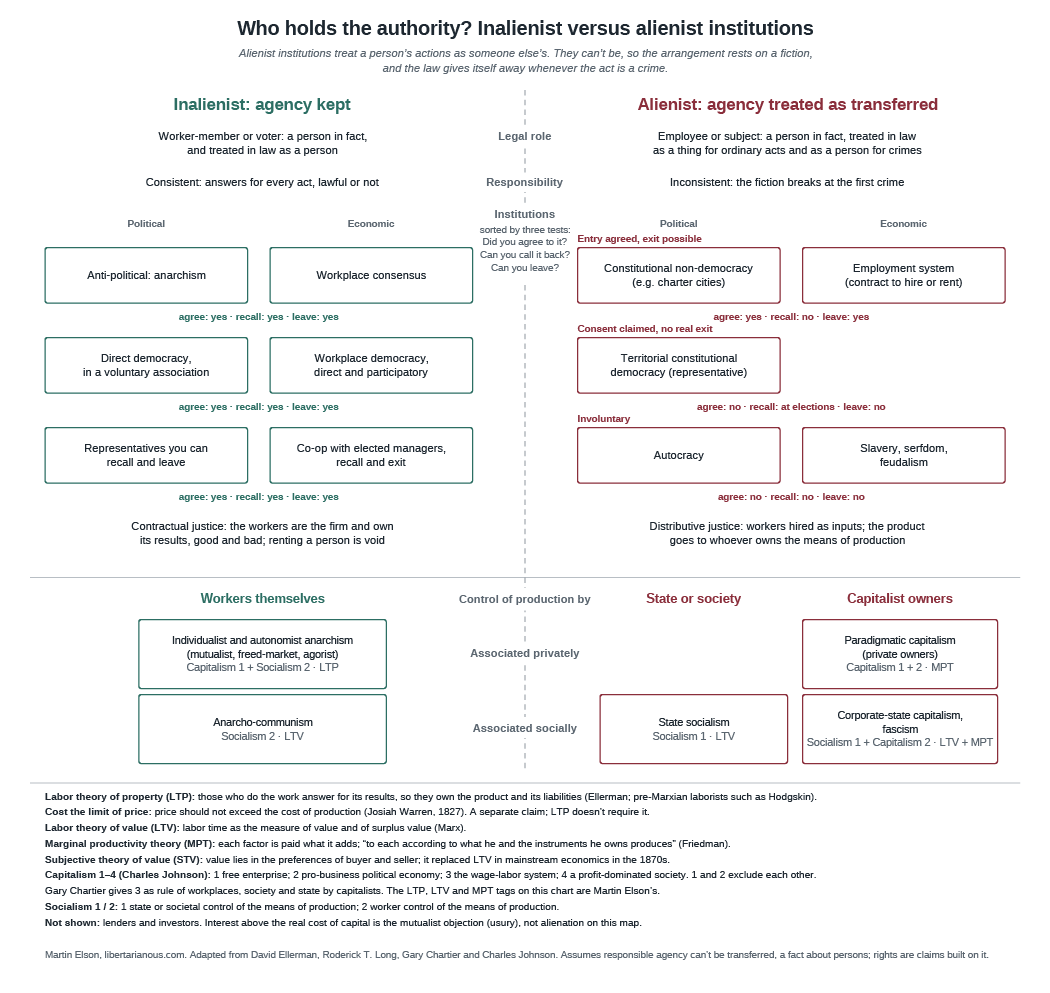
The same test sorts the firm and the state in Property Without Propertarianism.
The strongest case against
Josiah Tucker, Dean of Gloucester, read Locke more carefully than most of Locke’s admirers. If consent is the ground of government, he saw, no government on earth has ever stood on it, and none could. In A Treatise Concerning Civil Government (1781) he put it in one line: “the Lockian System is an universal Demolisher of all Civil Governments, but not the Builder of any.” Six years earlier he had written that Locke’s principles, carried out to the letter, would unhinge and destroy every government on earth. Sir Robert Filmer had pressed the same point a century before, and Hume pressed it on his own terms: allegiance rests on custom and the plain usefulness of order, not on any promise. Carl Watner, whose history of the idea this page draws on, counts Filmer and Tucker as consent theory’s most perceptive critics, because they saw where it led.
They were right about the logic. Held strictly, consent theory does what Tucker said: it leaves no existing state with authority. Tucker and the anarchist share the premise and differ only on which side to drop. Tucker keeps government and drops consent. The anarchist keeps consent and drops the claim to rule.
Why keep consent? Because we keep it everywhere else. Consent is the line between surgery and assault, sex and rape, a gift and a theft. A theory that holds that line for every person and waives it for one organization claims for some what it would never grant to everyone, and that fails Ingersoll’s test. Tucker’s alarm also rests on a slide Hume makes too, from “no government rests on consent” to “without government there is no order.” Order doesn’t need a ruler’s title; Order Without a Master Plan makes that case. Drop the claim to authority and the roads, the courts and the neighbors are still there. What goes is the right of one body to command everyone in a territory whether they agreed or not.
The second objection comes from the other side, from Jean-Jacques Rousseau. Sovereignty, he argued, can’t be represented, for the same reason it can’t be alienated: a will can’t be handed to someone else. The English think they are free, he wrote, but they are free only while electing members of parliament; once the members are chosen, the people are slaves. On this view the line runs between direct and representative democracy, and a town meeting passes where a parliament fails. Rousseau is right that representation can become a sale. But form doesn’t decide it. A direct democracy that binds a minority who never joined and can’t leave alienates them just as surely, and Rousseau’s own general will, which may force a man to be free, shows how. Three tests decide it: did you agree to it, can you call the authority back, and can you leave? A cooperative with elected managers can pass all three. A territorial state fails the first and the third whether it votes by town meeting or by parliament.
The third objection comes from the market. Drop the state, it says, and let people hire their protection. Murray Rothbard and David Friedman pictured competing defense agencies, each resting on its clients’ actual consent. That passes the test, but only for the clients. The people a hired force is pointed at never agreed to it, can’t recall it, and often can’t get out of its reach. The Pinkertons Henry Clay Frick brought to Homestead in 1892 answered to Carnegie Steel, not to the strikers they were sent against. The Blackwater guards who killed seventeen Iraqi civilians in Nisour Square in 2007 answered to a State Department contract, not to anyone in Baghdad. A private force breaks the monopoly in form only, because it answers to whoever pays. The question is not who signs the check but whether the people an enforcer acts on can refuse it, recall it and leave it. Gary Chartier’s legal regimes, in Law Without a Monopoly, are meant to pass that test. A mercenary fails it as surely as a state.
Where this lands
Consent of the governed is the right test, and no state passes it. That is not a quibble about paperwork. Authority over a person’s acts may be lent, never sold: lent to a delegate who answers to you, whom you can recall, in an association you can leave. A boss who claims your working hours and a state that claims your obedience make the same claim, and it is void for the same reason. The floor in What Rights Are puts it in a line: no one may be used as an input, and an enforcer you can’t leave, vote out, recall or hold to its own rules is using you as one. Law Without a Monopoly asks what law looks like when every enforcer has to pass that test. Why so many people defer to a state that fails it, without ever having consented, is the question of Power Distance. Read at its word, the Declaration’s sentence is an anarchist sentence. Its authors didn’t mean it that way. Warren did.
Sources
- Charles W. Johnson, “Can Anybody Ever Consent to the State?” (Rad Geek People’s Daily, 8 January 2009). The opt-out principle; why even willing subjects can’t consent. original · copy here
- Carl Watner, “‘Oh, Ye Are For Anarchy!’: Consent Theory in the Radical Libertarian Tradition” (Journal of Libertarian Studies 8, no. 1, Winter 1986, pp. 111–137). Filmer and Tucker as the theory’s sharpest critics; Thoreau, Lane and Spooner. full article (PDF) · copy here (part II)
- Crispin Sartwell, Against the State: An Introduction to Anarchist Political Theory (SUNY Press, 2008). The claim Johnson defends: existing states can’t be consented to.
- John Locke, Second Treatise of Government (1689), ch. 8, §§95, 119–122. Consent, tacit consent, and express consent as perpetual. Public domain.
- Hugo Grotius, The Rights of War and Peace (1625), bk. 1, ch. 3, §8. From the slave contract to a people’s surrender of sovereignty. Public domain.
- Thomas Hobbes, Leviathan (1651), chs. 16–17. Authorization: the subject as author of the sovereign’s acts. Public domain.
- Samuel Pufendorf, Of the Law of Nature and Nations (1672), bk. 7, ch. 2. The two contracts, unionis and subjectionis. Public domain.
- Lysander Spooner, No Treason no. 2 (1867) and no. 6, “The Constitution of No Authority” (1870). The unsigned constitution; the ballot and the bullet. Public domain.
- Articles of Confederation (1781), art. XIII; U.S. Constitution (1787), art. VII; Jonathan Elliot, ed., The Debates in the Several State Conventions on the Adoption of the Federal Constitution, vol. 3, pp. 22–23 (Virginia, 4 June 1788). Unanimity set aside for nine states; Patrick Henry’s “We, the people.” Public domain.
- David Hume, “Of the Original Contract” (1748). The peasant, the artisan and the ship. Public domain.
- Josiah Tucker, A Treatise Concerning Civil Government (London: T. Cadell, 1781), and A Letter to Edmund Burke (2nd ed., 1775), in Robert Livingston Schuyler, ed., Josiah Tucker: A Selection from His Economic and Political Writings (Columbia University Press, 1931), pp. 459 and 378. The Lockian system as a demolisher of governments. Public domain. Online Library of Liberty · Folger record
- Josiah Warren, True Civilization an Immediate Necessity (1863), §§35, 62. Consent as the end of government (§62); self-preservation or Sovereignty can’t be alienated (§35). Public domain. Anarchist Library
- Jean-Jacques Rousseau, The Social Contract (1762), bk. 1, ch. 7 and bk. 3, ch. 15. Forced to be free; sovereignty can’t be represented. Public domain.
- H. L. A. Hart, “Are There Any Natural Rights?” (Philosophical Review 64, 1955), and John Rawls, “Legal Obligation and the Duty of Fair Play” (in Sidney Hook, ed., Law and Philosophy, NYU Press, 1964). Fair play.
- George Klosko, The Principle of Fairness and Political Obligation (Rowman & Littlefield, 1992). Fair play for goods no one can do without.
- Robert Nozick, Anarchy, State, and Utopia (Basic Books, 1974), ch. 5. The public address system.
- Ronald Dworkin, “The Original Position” (University of Chicago Law Review 40, 1973, pp. 500–533), reprinted in Taking Rights Seriously (Harvard University Press, 1977), ch. 6. A hypothetical contract is no contract.
- David Estlund, Democratic Authority: A Philosophical Framework (Princeton University Press, 2008), ch. 7. Normative consent.
- A. John Simmons, Moral Principles and Political Obligations (Princeton University Press, 1979), and Michael Huemer, The Problem of Political Authority (Palgrave Macmillan, 2013). The fullest modern surveys of why each theory of political obligation fails.
- David Ellerman, “Listen Libertarians! Part I: The fundamental consent-versus-coercion misframing” (ellerman.org, 2012). Alienation versus delegation. original
- Murray N. Rothbard, For a New Liberty (Macmillan, 1973), ch. 12, and David Friedman, The Machinery of Freedom (2nd ed., Open Court, 1989), part 3. Private defense agencies.
- Paul Krause, The Battle for Homestead, 1880–1892 (University of Pittsburgh Press, 1992). The Pinkertons at Homestead.